

Women in Leadership: The Emotional Intelligence Skills That Drive Workplace Wellbeing
What a study of 43,080 women across 114 countries tells us about thriving, and what organizations can do about it
by Patricia E. Freedman, Ilaria Iseppato (PhD) & Joshua M. Freedman, MCC | Six Seconds

Wellbeing at work is not a mystery. Now we have evidence it’s predictably linked to key skills, and they are learnable.
Most organizations assume they know how to manage women’s wellbeing at work. Those assumptions have shaped how companies invest in leadership development, retention, and engagement programs. And according to a new peer-reviewed study of 43,080 women across 114 countries, those assumptions are wrong.
The new peer reviewed study, Into the headwinds: key emotional intelligence capacities that predict women’s workplace wellbeing across job roles is in Frontiers in Organizational Psychology. It analyzed the women’s leadership pipeline and wellbeing through six years of emotional intelligence (EQ) assessments, focusing on the concept of Brain Talents – learnable, measurable, actionable EQ skills correlated with performance outcomes. Five of the emotional intelligence Brain Talents stood out as essential for women leaders.
Assumption 1: Wellbeing rises with seniority.
What the research found:
This one seems intuitive. Senior executives have more autonomy, more resources, more flexibility. And at a population level, the data confirms it: women’s wellbeing does follow a staircase pattern. The higher your job level, the better your wellbeing.
At the same time, the study uncovered a surprising finding: Three of the five Brain Talents, Commitment, Resilience, and Proactivity, are the strongest predictors of wellbeing. When women are strong in all three, the staircase flattens. Women are 8.6 times more likely to have high workplace wellbeing, and with these talents career level largely stops predicting who thrives. Students and senior executives with strength in all three talents showed the highest wellbeing of all.
Each strong Brain Talent a woman leverages increases wellbeing by roughly 12 percentage points. The effect is cumulative, a build-as-you-go dynamic. Women strong in all three reached high wellbeing 58% of the time, versus just 21% for those strong in none.
Your career level is not as important as your EQ skills in these three capacities. Women developing Commitment, Resilience, and Proactivity at any career stage can access higher levels of wellbeing.
When women are strong in all three of the top Brain Talents, Commitment, Resilience, and Proactivity, they are 8.6 times more likely to be thriving at work. And the wellbeing gap between career levels essentially disappears. That means women at any stage of the leadership pipeline can unlock these resources. That changes the conversation about what organizations can do for their employees.
Assumption 2: Invest broadly in leadership development.
What the research found:
Organizations spend heavily on development programs, retention strategies, and wellbeing initiatives. Sometimes these produce real breakthroughs. Often there is little to no change. The difference comes down to targeting the right capabilities for the right results.
The study found that of 18 Brain Talents measured by the SEI, five stood out as keys to wellbeing:
- Commitment (maintaining attention on what is important)
- Resilience (bouncing ahead)
- Proactivity (acting based on internal drive)
- Imagination (seeing the unknown)
- Risk Tolerance (handling stress and complexity).
These five form a “Resource Caravan.” They are the capabilities that differentiate women across job roles and predict whether they thrive.
The remaining 13 Brain Talents showed substantially smaller differences across career levels, but are likely to be important for other outcomes. For wellbeing, these five are uniquely sensitive to organizational conditions. The starting point is to define the performance goal, and work backward to ascertain the specific resources that drive the desired outcome. Then focus on the measurable, developable drivers.
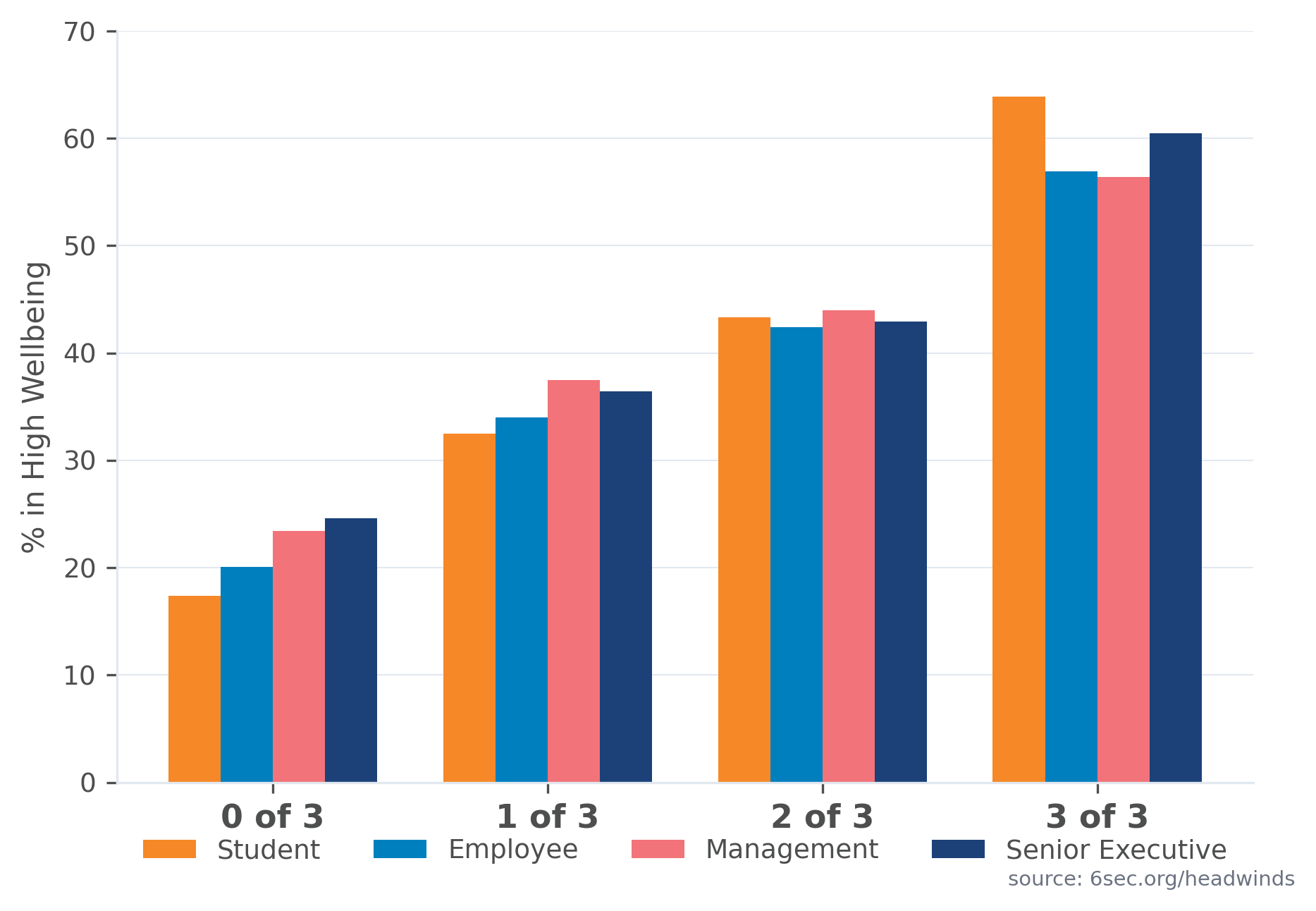
The graph above shows the “dose effect” impact when women have more of the crucial Brain Talents. There are 4 groups (students, employees, managers, senior executives) — on the left, women who have high scores on 0 of these specific talents have much lower wellbeing… and the higher the job-level, the higher the wellbeing. Progressing to the right, women with 1 of the talents score higher on wellbeing, then with 2 score even higher. On the right, women with high scores on 3/3 of the talents have 58% higher wellbeing — irrespective of job role.
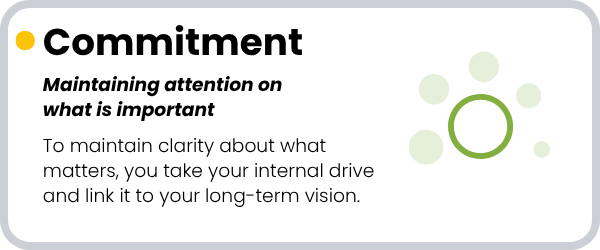
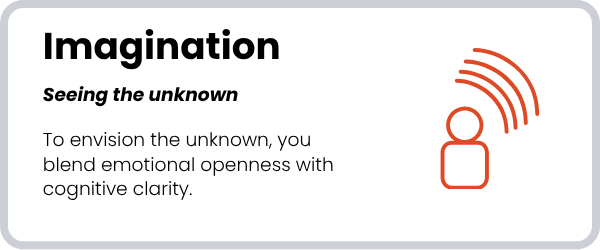
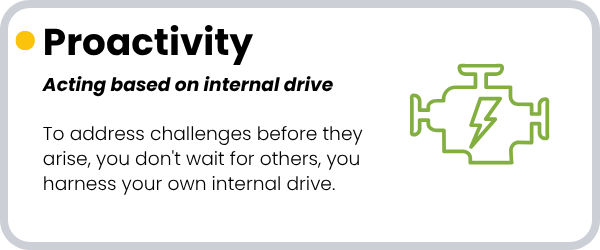
Organizations ask us, where do we start if we want to prioritize wellbeing? This research gives a clear answer. There are five specific EQ Brain Talents that predict thriving, they’re measurable with the SEI, and they’re developable through training and coaching. You just need to focus on the right capabilities.
Assumption 3: Support women equally across the pipeline.
What the research found:
This sounds fair. But the data says it misses the point.
Women in middle management showed the largest wellbeing decline of any group and were the only group that never recovered to 2019 levels. The first promotion into management remains the most persistent bottleneck in women’s careers, and women managers report the highest burnout of any group in the workforce. Gallup’s 2026 data confirms the paradox: women managers show 34% engagement alongside 34% burnout, simultaneously the most effortful and most depleted group. HBR research found that middle managers feel less psychologically safe than both their bosses and their direct reports.
Managers weren’t short on emotional intelligence. Their scores were higher than employees’ and students’. They were short on the organizational support to use it. The paper frames the manager transition as a “resource passageway” organizations can open or block by design.
Middle managers are where women’s wellbeing drops the most, but that’s also where supporting these emotional intelligence capacities can make the biggest difference. When women here get support, the effects ripple both up and down the organization.
Three things you can do Monday morning
The new study provides practical action-steps to improve the leadership pipeline and strengthen sustainable performance:
Across 114 countries, women in middle management consistently show the steepest wellbeing decline. They carry the emotional demand of supporting their teams but lack the resources senior leaders have. Our data shows this is the highest-leverage point for organizations to invest in EQ development.

Measure
Use the SEI to assess Commitment, Resilience, and Proactivity across your workforce. You can’t develop what you can’t see.

Develop
These capacities grow through training and coaching. Six Seconds programs like EQ for High Performance and Mentoring Activation (with Leadership Shapers) build these specific Brain Talents. Pre and post assessment gives you proof of impact.

Target
Start with middle management, the only group with year-over-year declines. The return ripples across the entire leadership pipeline.
The full peer-reviewed study, “Into the Headwinds,” is available at doi.org/10.3389/fpsyg.2026.1848879.
To explore how these findings apply to your organization, schedule a conversation at 6sec.org/talk.
For more on leveraging the value of EQ, we recommend:

- How to Stop Second-Guessing Your Decisions: Four emotional intelligence practices for overthinkers - July 20, 2026
- Women in Leadership: The Emotional Intelligence Skills That Drive Workplace Wellbeing - June 8, 2026
- Resource Caravan: What would you take on a journey of a lifetime? New Research on Women Leaders Wellbeing and Emotional Intelligence - June 3, 2026