


How to Stop Second-Guessing Your Decisions
Four emotional intelligence practices for overthinkers
by Patty Freedman
It took me eleven days to buy a chandelier for the dining room.
I had a spreadsheet: Brightness, finish, how low it would hang over the table, price, return policy. I kept adjusting what I was willing to spend, always upward, always with a reason. I read reviews from strangers who described their freshly lit dining rooms like meeting a celeb crush at the airport. I ordered one. Then I canceled it. Then I ordered a different one, and for two weeks after it went up I kept glancing at it as I came down the stairs, wondering about the other one.
It was never really about the chandelier. It’s the deciding.
I worry about my decisions. Before I choose, I want to find the best one, which means running down every outcome of every option until I’ve built a fourth-order case against a light fixture at 2 a.m. In Six Seconds language, my Consequential Thinking works overtime, which sounds like a compliment until you meet it in the dark.
Then I choose. And I go back and check the work. Was that the right one? Should I have waited for the sale? What did I miss?
The worrying doesn’t end when the decision does. That’s the part that took me years to notice.
Barry Schwartz and his team would call me a Maximizer. In their research, people driven to find the very best option report more regret, more comparing, and less satisfaction with what they chose than people who find something that meets their standard and get on with their lives. They also score higher on perfectionism (hello me!), which felt a little on the nose.
Here’s the thing about maximizers. We aren’t making worse choices. We’re just enjoying them less.
Changing your mind
In 2002, Daniel Gilbert and Jane Ebert’s work on decision making also captures my dilemma.
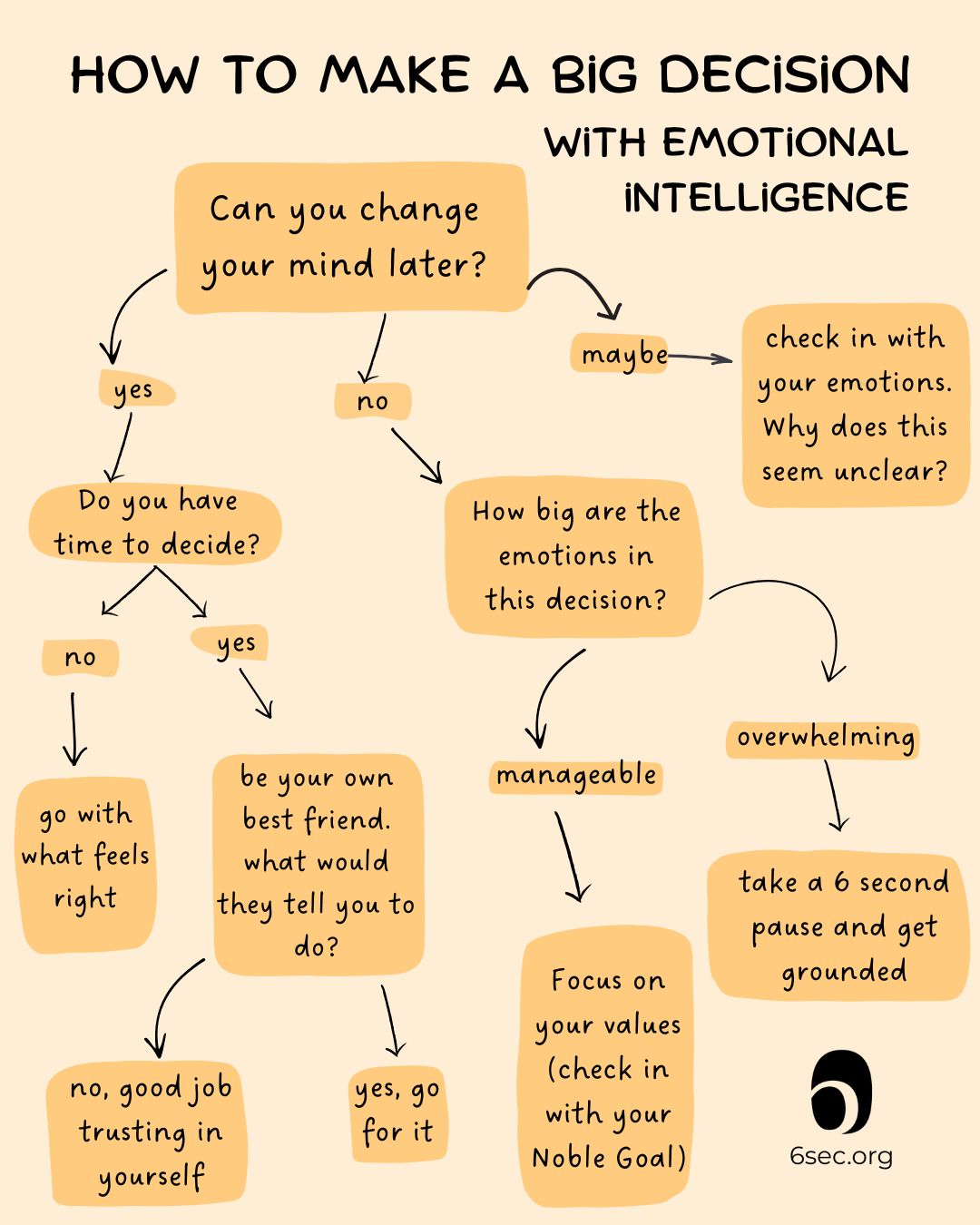
Students in a photography course took pictures, printed their two favorites, and chose one to keep. Some were told the choice was final. Others were told they could swap it within a few days if they changed their minds. When asked ahead of time, most students said they’d want the flexible version of the decision. But the students who could change their minds ended up liking their photograph less. The open decision kept them considering, questioning, ruminating on the decision. The ones who were stuck with their choice went to work finding reasons to love it, without ever noticing they were doing it.
I had always treated the escape hatch as a kindness I was doing for myself. It turns out the escape hatch was the thing keeping me from finding peace.
Which is probably why the chandelier stopped bothering me the week the box went to recycling and the return window closed. Nothing about the chandelier changed. What changed was that I could no longer take it down.
A Coin Flip for Indecision
The economist Steven Levitt wondered what would happen if he simply pushed people off the fence.
He invited people who were genuinely stuck on a decision to flip a virtual coin. Heads meant make the change. Tails meant stay put. More than twenty thousand people flipped, over things as small as a haircut and as large as leaving a job or a marriage.
People who got heads were about 25 percent more likely to actually make the change. Six months later, the ones the coin had pushed toward change were happier than the ones it had told to stay. Levitt’s conclusion was that we are far too cautious about the choices that matter most.
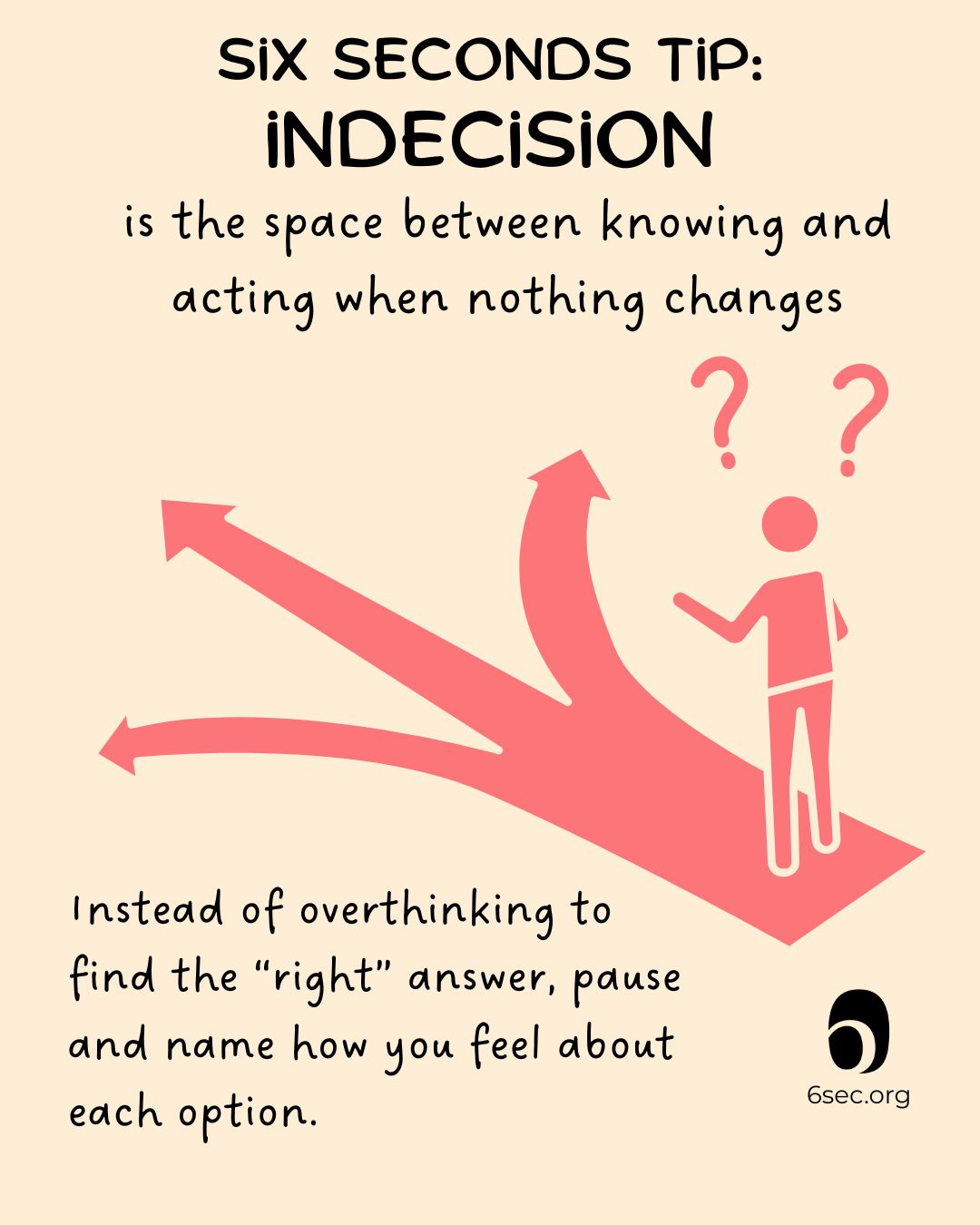
I don’t recommend outsourcing your life’s decisions to a quarter. But I read my own “feeling stuck-ness” differently now. Eleven days of circling isn’t a sign I need more information. It’s a sign the options are close, and the deciding has become harder than the choice.
When the Feelings Don’t Agree
Part of what kept me circling was that I felt two ways about the same option, and I kept reading that as proof I hadn’t figured it out yet.
A Six Seconds colleague wrote about choosing between two job offers. He laid out Mixed Emotions cards for each one. Under the first: safe, trapped, unfulfilled, resentful. Under the second: curious, afraid, inadequate, empowered.
The cards didn’t tell him what to do. What they showed him was that his fear and his excitement were pointing at the same thing. Two expressions of one need. Once he could see that, the fear stopped being a reason to say no.
That’s the part I keep coming back to. Conflicting feelings about a choice aren’t evidence that you’re confused. They’re usually evidence that the choice is real, and that something you care about is sitting on both sides of it.
The Mixed Emotions deck is built for exactly this. Lay out a card for each option, then choose the cards for how you imagine feeling when you say yes to it.
Four Things I’m Practicing
So recently I’ve stopped trying to make the BEST choice. That’s a shift for me, and here’s what replaced it.
1. Name the feeling before you name the options
Nine times out of ten, the thing underneath my stuckness is some version of fear. That I’ll waste money. That I’ll look foolish. That someone will be disappointed in me. Fear is real information, but it’s information about me, not about light fixtures, and I was letting it show up as “research.”
There’s a reason naming helps. When Lieberman and his colleagues watched people put feelings into words inside an fMRI scanner, amygdala activity went down and the thinking part of the brain came online. Naming a feeling isn’t just describing it. It’s how you give yourself a little distance from the scenario to think.
EQ Tip: Before you open a single tab, name what you’re feeling. This is the skill of Enhance Emotional Literacy. → What am I feeling right now (and what else, and what else)? → What is the feeling telling me? Is this feeling about the choice, or about something else?
2. Set the bar before you start looking
I’m too flexible with my limits. They slide upward, always with a very good reason, and by day nine I’m pricing lights at double what I said I’d spend. A bar set in advance is kinder to myself than one that keeps moving, because the moving one can never be met.
EQ Tip: Write one sentence before you begin. Then take the first option that clears it. → This choice is good enough if it ________. → What am I willing to give up to get that?
3. Firmly close the door
Gilbert’s photography students didn’t get happier because they chose better. They got happier because they couldn’t go back, so their minds finally stopped reconsidering.
EQ Tip: Say it to yourself, or to someone else, in the past tense. → This is the one. I chose it with the best information I had at the time. → What can I do now with the energy I’ve been spending on second-guessing?
4. Ask what you’d tell a friend
You can untangle your friend’s job situation in four minutes and then spend eleven days on a light fixture. Researchers call this Solomon’s Paradox, after the king who had wisdom for everyone but himself. Grossmann and Kross found that people who considered their own problem in the third person reasoned just as wisely as people advising a friend.
EQ Tip: Get out of your own head by getting out of first person. This is Increase Empathy pointed back at yourself. → What would I tell a friend in this exact situation? → Why does she feel this way? What is she actually considering?
Final Thought: You Are Allowed to Stop Deciding
If deciding feels hard, that’s your brain doing its job, protecting you from risk. But protection that never switches off isn’t safety. It’s a cost to your resources and may keep you from paying attention to more important things.
Schwartz’s maximizers weren’t making bad choices. They were making good ones and unable to enjoy them. The photography students who couldn’t swap their prints weren’t smarter. They were free to enjoy what they had.
So make your next decision (where to go for dinner, which sweater to wear, or how much to spend on your trip) with what you know today. Then close the door, and go sit under your own imperfect, entirely lovely dining room light.
For more articles, I recommend:

- How to Stop Second-Guessing Your Decisions: Four emotional intelligence practices for overthinkers - July 20, 2026
- Women in Leadership: The Emotional Intelligence Skills That Drive Workplace Wellbeing - June 8, 2026
- Resource Caravan: What would you take on a journey of a lifetime? New Research on Women Leaders Wellbeing and Emotional Intelligence - June 3, 2026