

Resource Caravan: What would you take on a journey of a lifetime?
Insights from new research on women leaders, wellbeing & emotional intelligence
by Patty Freedman
For some people, the big turning-point birthdays are 40 or 50. For me it was 25. I wasn’t dreading it exactly, but when it arrived, I felt suddenly, unexpectedly old. My student life was really over. My adult life stretched out ahead of me and I genuinely didn’t know where I was headed. I looked around at friends who seemed to have ticked things off the list — careers taking shape, apartments, a sense of direction — and I felt behind. I hadn’t accomplished what I thought I should have by now. I didn’t know what came next.
Anabel Jensen, President of Six Seconds, was at the time one of my grad school advisors and she had a gift for asking questions that made you stop and think. She noticed I was spending a lot of time being busy and not much time being.
Anabel asked me to think about what I wanted to contribute to the world, in large or small ways, and how I wanted to leave my mark. That conversation revealed something to me I hadn’t considered before; that life could be an interesting adventure. Not a list of tasks to do, but a marvelous journey.
C.S. Lewis wrote: “When I became a man, I put away childish things, including the fear of childishness and the desire to be very grown up.” I didn’t know it then, but that anxious checklist I was running through on my 25th birthday was exactly that — the fear of childishness, the overwhelming desire to be very grown up, without the wisdom to know it is okay to appreciate the journey of our life, not just the shiny moments. This month at Six Seconds we are thinking about June as a journey — not a destination, not a checklist. And that 25-year-old version of me is exactly who I had in mind when I started writing this.
When I was 25 I didn’t have a name for what positive psychology researcher Dr. Tal Ben-Shahar calls the Arrival Fallacy — the belief that reaching a particular milestone will finally produce the lasting sense of fulfillment we’ve been waiting for. The problem is that when we arrive, the feeling is fleeting, or doesn’t come at all. And when it doesn’t, we assume something is wrong with us, rather than recognizing the flaw in the expectation itself.
Essential Resources for the Journey: New Research on Emotional Intelligence for Wellbeing
I’m thrilled to share that together with my co-authors Ilaria Iseppato, Daniel Choi, and Joshua Freedman, we’ve just released a new research paper that asks “what are the essential tools you need for your journey to have good wellbeing?”
Into the Headwinds research examined data from 43,080 women across 114 countries over seven years. We wanted to understand which emotional intelligence capacities actually predict wellbeing across a woman’s career — from student all the way to senior executive. Not which milestones they’d reached. What they were carrying.
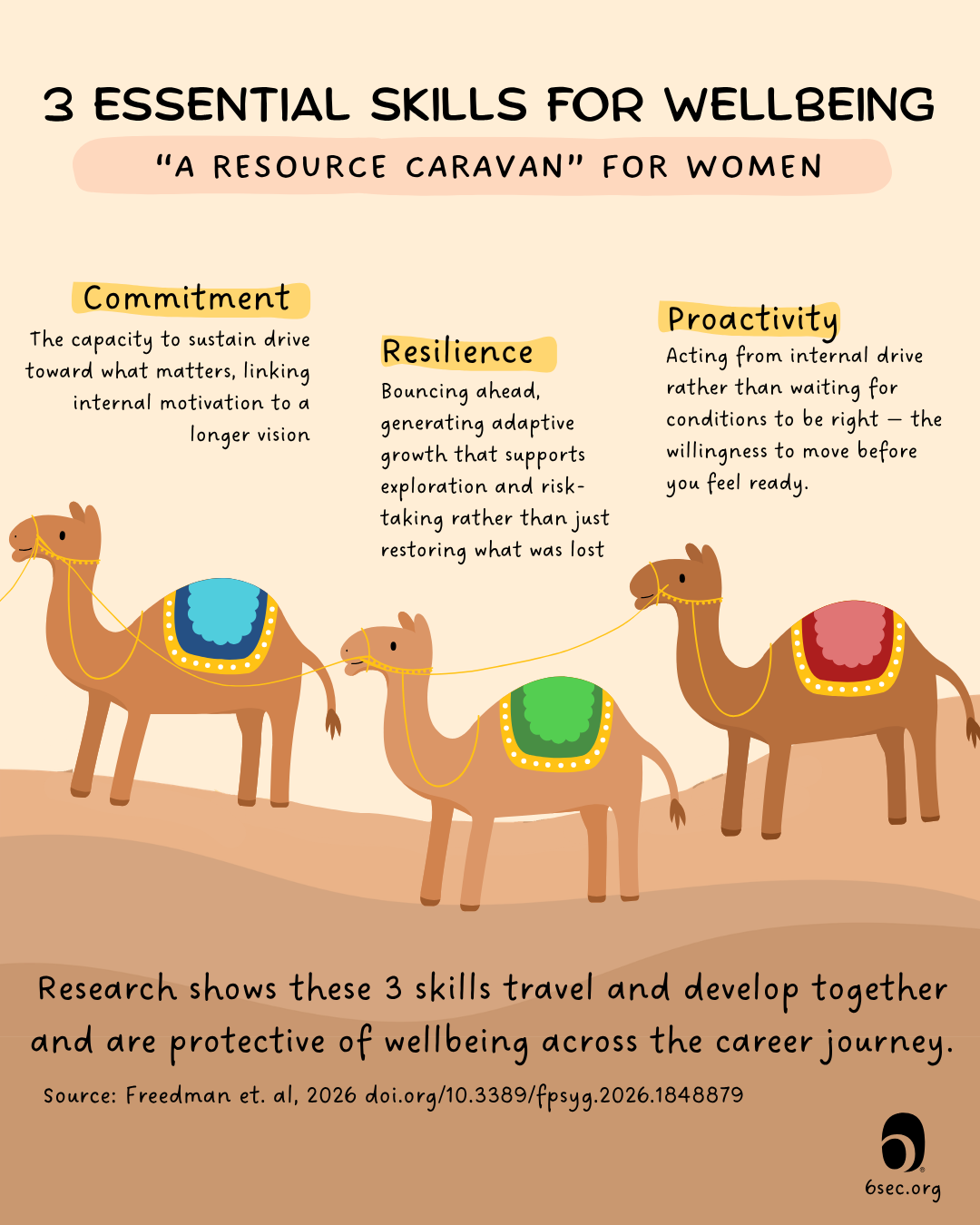
We identified five EQ Brain Talents that rose with each career level and were most strongly associated with wellbeing: Commitment, Resilience, Proactivity, Imagination, and Risk Tolerance. These five form what we call a “Resource Caravan” — skills that travel together and develop together, and that the research shows are most protective of wellbeing across the career journey.
The strongest combination of all was what we called the Resource Triad: Commitment, Resilience, and Proactivity. Divide all the women in the study in 3 equal groups based on their scores on these skills; those groups are called “terciles.” Women in the top tercile on all three were 8.62 times more likely to report high wellbeing than women in the bottom tercile. That held across career levels, across regions, across seven years of data.
Here’s what struck me most. The effect was actually strongest for students — women at the very beginning of the journey, before they’d reached any of the milestones that our culture tells us should predict success and fulfillment. Women who had developed these three skills early were over 13 times more likely to report high wellbeing than those who hadn’t. In other words, starting on EQ early has even more value. The skills didn’t wait for them at the top. They were what made the journey sustainable.
We also found something that concerns me. Women managers — those in the squeezed middle of their careers — showed the largest decline in wellbeing and the greatest erosion of these skills over the study period. They never fully recovered to 2019 levels. If you are in that season right now, this research is for you.
What Can You Carry? Three Essentials for Workplace Wellbeing
The good news is that these skills are learnable. You don’t have to wait until you’ve reached a certain level to develop them. In fact the research suggests the earlier the better.
In our new research, Commitment and Resilience are the anchor resources — the hub around which the others organize.
- Commitment is the capacity to sustain drive toward what matters, linking internal motivation to a longer vision. It’s what Anabel helped me find at 25 when she asked me what I wanted to contribute.
- Resilience is not simply bouncing back from setbacks — the research describes it as bouncing ahead, generating adaptive growth that supports exploration and risk-taking rather than just restoring what was lost.
- Together these two create the conditions in which the third capacity, Proactivity, can operate. Proactivity is acting from internal drive rather than waiting for conditions to be right — the willingness to move before you feel ready. I felt that at 25.
These are not traits you either have or don’t. They are capacities you build, practice, and strengthen. And they travel with you (that’s one reason they’re called a “Resource Caravan”) — through every role, every transition, every season of the journey where you find yourself wondering if you’re far enough along.
Chasing Happiness: How Emotional Intelligence Builds Lasting Wellbeing
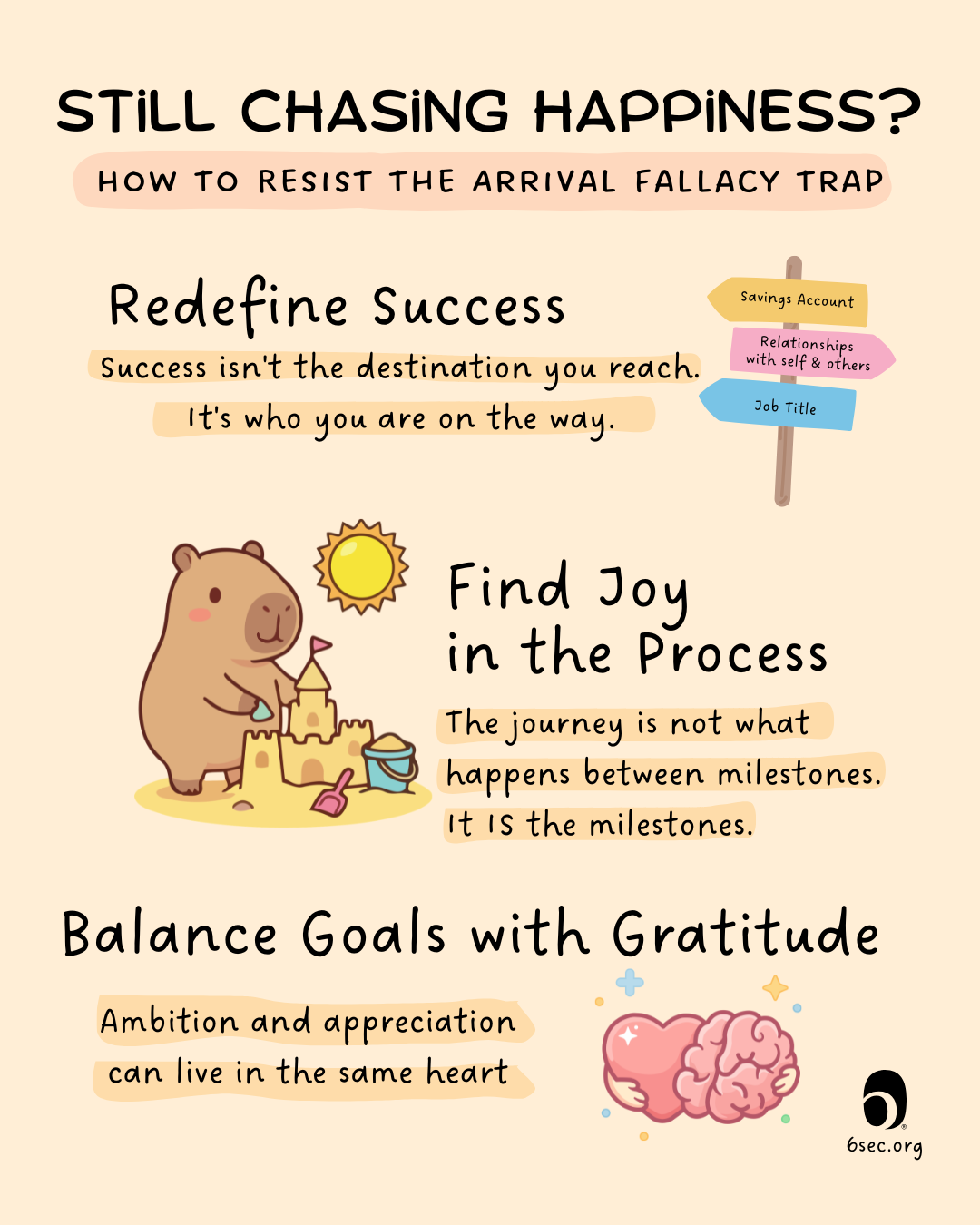
So what do we do about breaking free of the arrival fallacy trap? Here are three tips to help you reframe your journey and shift your mindset.
Redefine Success. Success isn’t the destination you reach. It’s who you become on the way. Hedonic happiness — the surface pleasure tied to external goals and milestones — is always just out of reach. But eudaimonic happiness, the deeper kind rooted in meaning and contribution, is available to you right now. We all want to have a legacy, but it’s not built backwards. You need to consider today what mark you are making on the world. If it’s not exactly right, you can adjust it.
Find Joy in the Process. The journey is not what happens between milestones. It IS the milestones. Ambition is important, but I’ve found it works best when it’s paired with genuine appreciation for what’s already here. What can you do to slow down and savour your relationships, your health, the place where you live? See if you can shift your attention just 1% every day to get back in the present.
Balance Goals with Gratitude. Ambition and appreciation can live in the same heart. Research on gratitude shows that it is strongly related to wellbeing across every measure — and the link may be unique and causal. What determines how well you travel — and whether you arrive at all — is what you carry with you. Consider who helped you get to this moment. Who in return are you lending a helping hand? The real value of working toward something isn’t the moment you get there. It’s who you become in the process of trying.
Your Turn EQ Day — June 6
This June, as part of our June Journey, we’re inviting you to make one commitment to practice emotional intelligence. Not because you’ve arrived somewhere. Because you’re on your way. Make your pledge at EQday.org and add your name to a global wall of people who are choosing to carry something worth carrying.
For #EQday 2026, I will ___.
For more articles, I recommend:

- How to Stop Second-Guessing Your Decisions: Four emotional intelligence practices for overthinkers - July 20, 2026
- Women in Leadership: The Emotional Intelligence Skills That Drive Workplace Wellbeing - June 8, 2026
- Resource Caravan: What would you take on a journey of a lifetime? New Research on Women Leaders Wellbeing and Emotional Intelligence - June 3, 2026