

Why the richness of your emotional life is an asset — not a mess to clean up. Here’s how to use emotional intelligence, and a little neuroscience, to shift from seeing a confusing “mess” of complex feelings… decoding them as a resource to point to what really matters.
Mixed Emotions: There’s Meaning in the Mix… Here’s how to find it.

Some years ago I collected a word I’ve loved ever since: discombobulated. It’s the feeling of having too many feelings at once — mixed emotions, none of them lined up neatly, all of them talking over each other. I used to treat that state as a problem; a signal that I’d lost the thread and needed to get myself back to something simple and clear.
I’ve come to see it differently.
What if that tangle isn’t a malfunction? What if it’s one of the most useful things about being human?
This is one of the Emotion Rules I keep coming back to (from my new book, Emotion Rules):
Emotions blend together, and there is meaning in the mix.
We don’t feel one emotion at a time. Life is layered, so our feelings are layered too. And the mixing isn’t noise to filter out… it’s information. The richness and diversity of what we feel is an asset, if we learn how to read it.
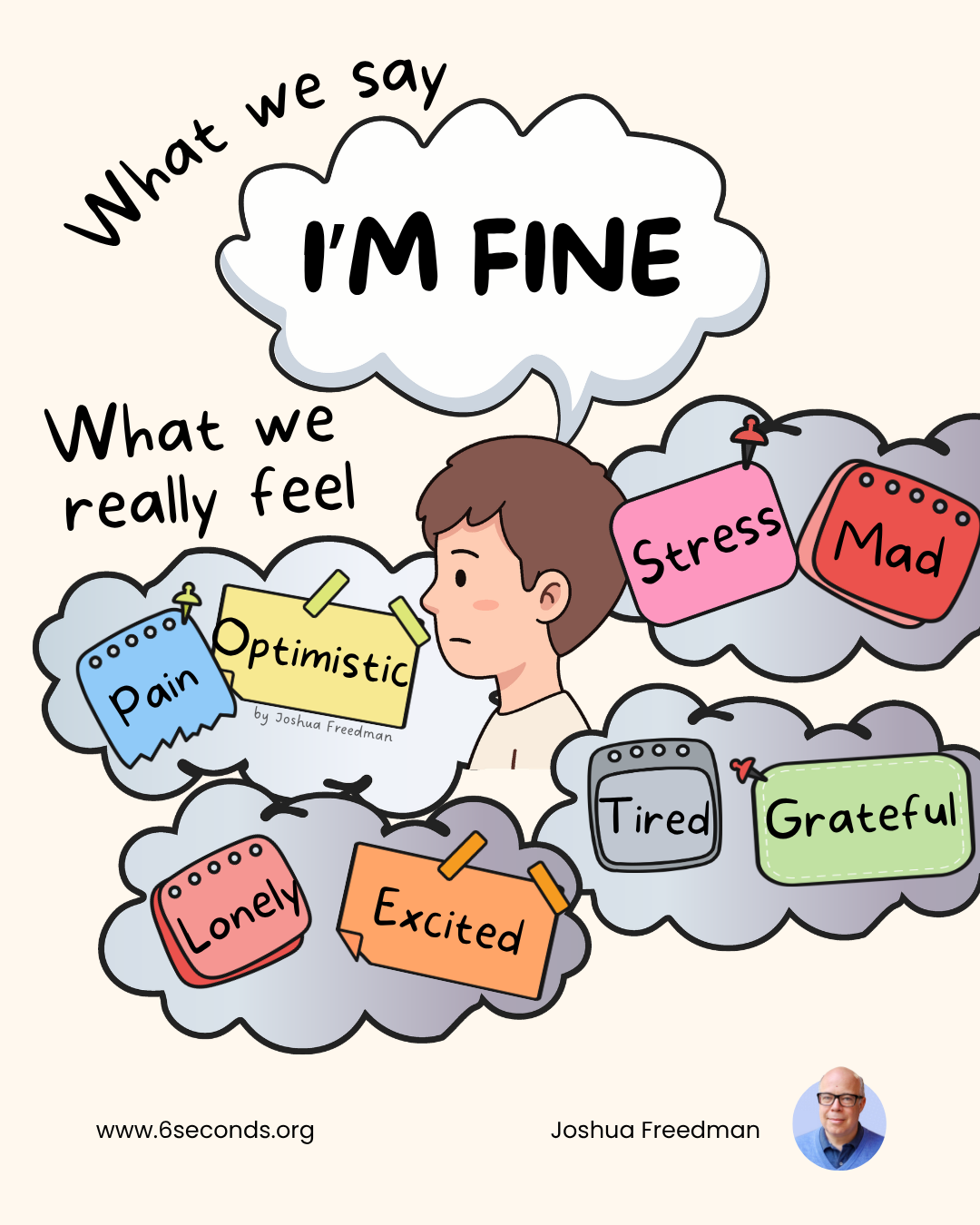
Picture an iceberg. What breaks the surface is real, but it’s a sliver of the whole: most of the mass sits underwater, out of sight, holding the visible part up. Emotions work the same way. The feeling you can name in a given moment (“I’m fine,” “I’m annoyed”) is the tip. Below the waterline is a much larger, richer body of experience: the other feelings mixed in with it, and the needs quietly driving them. Learning to sense what’s under the surface is where emotional wisdom lives.
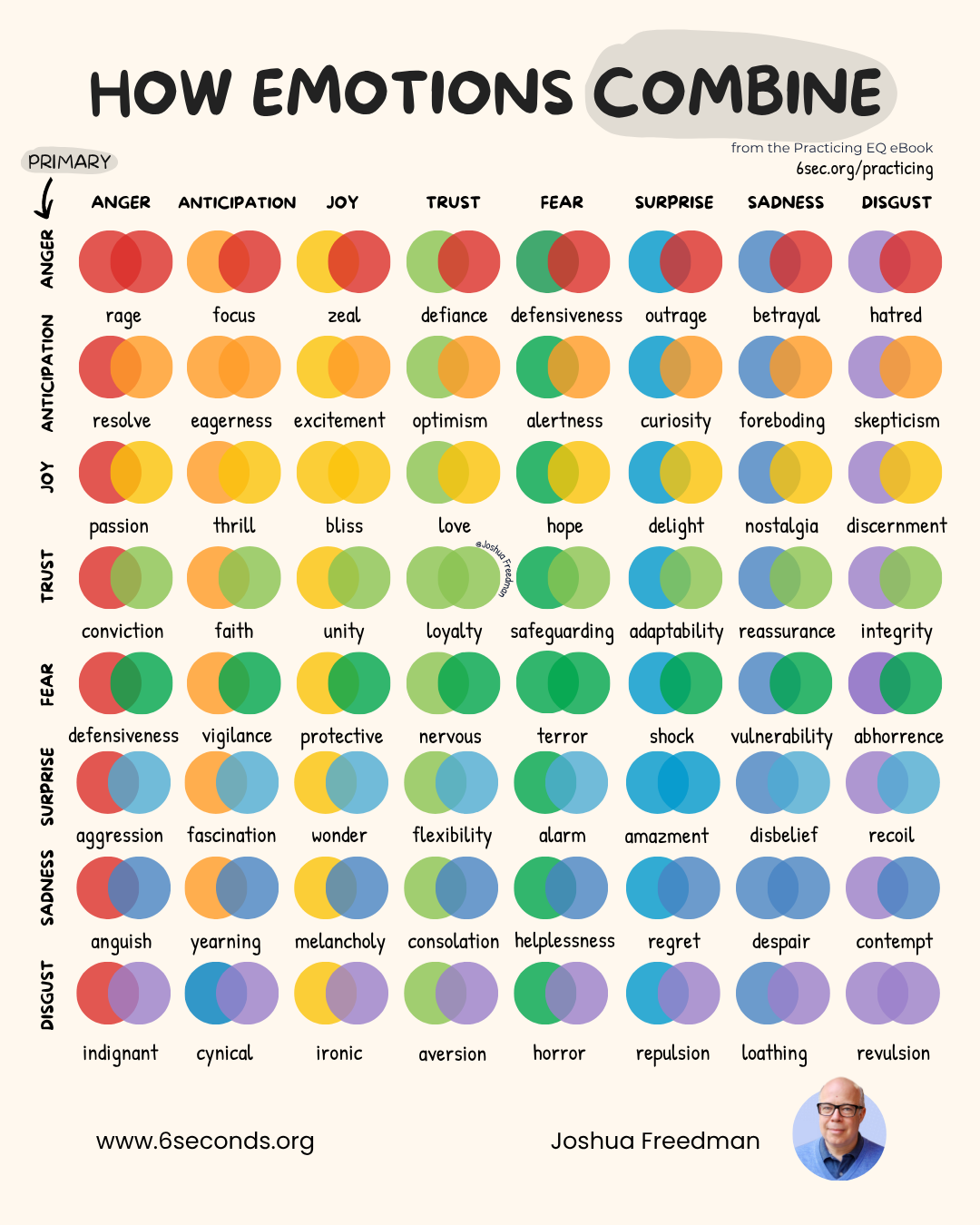
Psychologist Robert Plutchik mapped eight core emotions, and a lot of what we feel is those eight combining. Two ingredients meet and become something new:
- Joy + Trust becomes love.
- Fear + Surprise becomes awe.
- Anger + Sadness becomes betrayal.
Here’s the part I find fascinating: the order and intensity matter. Anger with a note of sadness reads as betrayal. Flip the proportions (mostly sadness, with an edge of anger) and you get anguish. Same two ingredients, different mix, different meaning.
That’s how we get from 8 basic emotions to the roughly 1,000 words on my feeling list. In my new book, Emotion Rules, I walk through more of these combinations… how the same ingredients, in different proportions, yield genuinely different feelings. It’s not that human beings are complicated for no reason. It’s that we have a genuinely rich instrument for sensing what matters to us.
Take awe. Researchers call feelings like it “cognitively saturated” — they’re not a simple physical reaction, they’re feeling and thought and sensation, braided together. My friend Michael Eatman puts it perfectly: “Can you feel there’s a lot going on there?” That “a lot going on” is exactly the point. A rich feeling is carrying a rich message.
Name it to claim it
When a complex feeling shows up, the first move isn’t to fix it. It’s to name it.
The neuroscientist Dan Siegel coined the phrase “name it to tame it,” and I love the ring of it. Though if we really believe every feeling is valuable, maybe we don’t want to tame our emotions. Maybe we want to engage them more fully. So I think of it as: name it to claim it.
There’s real science under this. In Emotion Rules, I explain a study where people approached a tarantula: the group that simply named their fear out loud — “I’m scared of this giant spider” — showed less fear a week later than the groups who tried to rationalize it away or distract themselves. Brain imaging studies point to why: when we put accurate words to a feeling, we get the thinking and feeling parts of the brain working together. Naming doesn’t suppress the emotion. It integrates it.
And naming does something else, something quieter and just as important. It gives the feeling an anchor. Once a swirl of sensation has a word, it becomes tangible — something you can actually hold, examine, and work with. Now you can make sense of it for yourself. And if you want to, you can hand it to someone else: “I’m feeling anguish, not just sadness.” Meaning is often co-created. When we put language to an experience, we invite other people into it — and that changes the experience itself. It’s why we grieve together, tell stories, and have rituals for naming what we go through.
How to understand mixed emotions: tease apart the tangle
Here’s where the richness becomes practical. A complex feeling is a knot, and you can gently untangle it into the threads woven inside. Each thread is worth listening to, because each emotion is pointing at a need.
I think of it as a constellation. Underneath a cluster of feelings, there’s usually a core human need — something like safety, belonging, achievement, autonomy, growth, or meaning. And that one need can send several different emotional messengers at once.
Say the need is achievement. It might surface as:
- Excitement when you sense progress.
- Anger when something blocks your way.
- Urgency when time is slipping.
- Pride when you hit a milestone.
- Disappointment when you fall short.
None of those cancel the others out. They’re like views of a mountain — a cliff from one side, a grassy slope from another. It’s the same mountain. And if you look from several angles at once, you can triangulate. You get a truer sense of where you actually are and which way to move.
So when the feelings pile up, instead of asking “which emotion is the right one?”, try:
- What is this feeling showing me about what matters?
- How does it fit with the others I’m feeling right now?
That’s the shift from being overwhelmed by the mix to being informed by it.
How to Untangle Mixed Emotions
Adapted from Emotion Rules
Got a big, mixed-up ball of feelings? You don’t have to sort it perfectly — you just have to care enough to listen. Three moves help:
Notice. Start with the body. Where are you tense, hot, cold, buzzing, still? Noticing shifts you out of abstract spinning and into what’s real, right now.
Name. Put words to it — a metaphor counts (“it feels spiky and hot”). Then ask: if this is a mix of basic emotions, what’s in mine? Naming gets your thinking brain and feeling brain working together.
Navigate. Treat the feeling as an ally, not a problem: If this is here to help me, what’s it pointing to — and what’s one good step forward?
Remember: there are no negative feelings. Every one is data — a message for you, from you.
A place to do the teasing apart
If you want a hands-on way to practice this, we built a tool for exactly this moment. The Emotional Constellation Map at 6sec.org/needs lets you explore how a feeling connects to the needs underneath it — mapping the emotion, the question it’s asking, and the core need it points toward.
It also has an emotion companion built in, powered by Claude AI, so you can put your own tangle into words and think it through in conversation — a way to actually name it to claim it in real time, rather than just reading about the idea.
The invitation
The next time you feel discombobulated, try not to rush past it. Pause and ask what’s actually in the mix. Give the biggest thread a name. Then follow it down to the need it’s pointing at.
Big or small, tidy or tangled, every feeling has something to show you. What surfaces is only the tip — and the richness beneath it isn’t a problem to solve. It’s the whole point.
You may also like…
