Jul 262011
 

What does it mean to feel, and why does it happen?  Today, most people see emotions as “good” or “bad” — which leaves us in a constant state of internal struggle against our own feelings.  Is there another option?  And how did we come to this point?

Imagine the “archetypal” child and parent; let’s take a boy, about eight years old.  His parent is busy dealing with 3.3 million tasks and chores, it’s been a long day and everyone’s on thin ice.  The child is going about the business of childhood and something happens – almost irrelevant what it is, perhaps his Wii stops working and, unsurprisingly, he gets upset — it’s been a long day for him too.  Let’s suppose he’s highly upset, unreasonably upset, and acts that out: he slams something down, he kicks something, he shouts, and overwhelmed by this rush of feelings (and afraid of his parent’s reaction) he starts to cry.

What is the parent’s typical reaction?


Dismissing Feelings

Perhaps asking a question, perhaps comforting, but more likely dismissing:  “Stop crying honey, it’s not that big a deal.”  “You shouldn’t get so angry.”  Or even the absolute dad-classic:  “Knock it off or I’ll give you something to cry about.”

What did the child just learn about these feelings?

What have you learned about these kinds of feelings – feelings like anger, fear, hurt, or jealousy?

Around the world, people have told me much the same thing:  Those are “negative” feelings.  Even “bad” feelings.  We find them uncomfortable, overwhelming, scary, out-of-control (and now we’re having “bad feelings” about our “bad feelings”).

So, the natural, reasonable, response to something bad?  Control it.  Push it away.  Cover it over.  Squish it.  Or at the very least, hide it.  Maybe after some therapy, “manage” it.

What about embracing it? 

Increasingly we’re happy to do that with “positive” emotions — the current fad is that if we’re not flooding our families, schools, and offices with bliss then perhaps we’re just mean (because “happiness” is seen as ideal).  But even this attitude is fraught with judgment; we’re limiting the motivating power of feelings to a select few.  We’re deciding that some emotions are good… which requires that others are bad.

In the last 14 years of teaching about emotions as a driver for positive change, I’ve come to consider that this vilification of our own emotion is the single biggest obstacle to emotional intelligence.

So I’d like to propose a different way of thinking about emotions. First, let’s explore an intriguing model from a scientist named Robert Plutchik.

Plutchik studied the way animals experience, express, and respond to emotions.  He saw, following in Darwin’s tradition, that there is an adaptive purpose to emotion.  Feelings help animals survive by alerting them to threats and opportunities, and by providing a universal, cross-species communication mechanism.  If you’ve ever heard the angry snarl of a wolf, or been enchanted by a puppy’s playful grin, you’ll understand this viscerally.

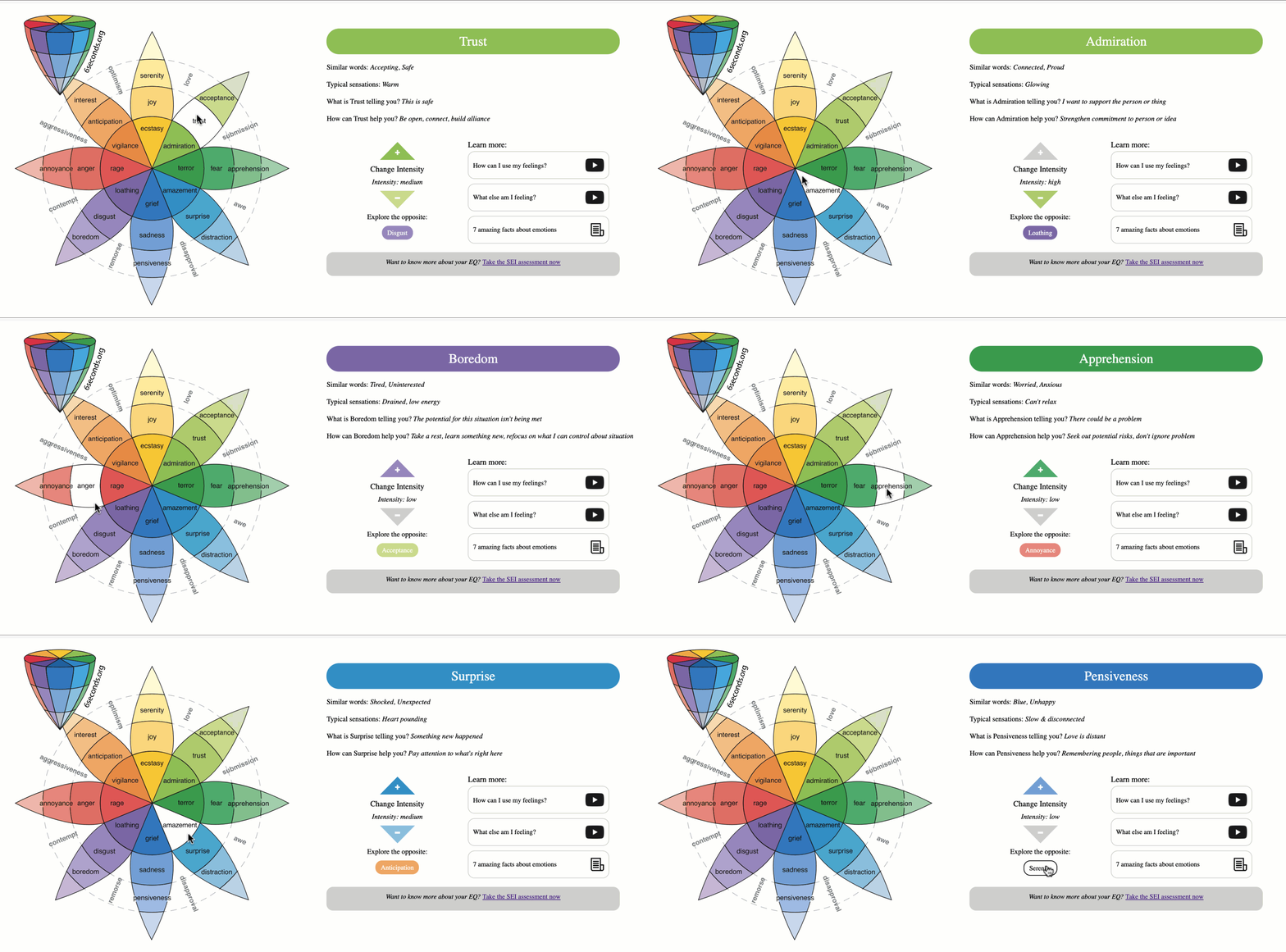
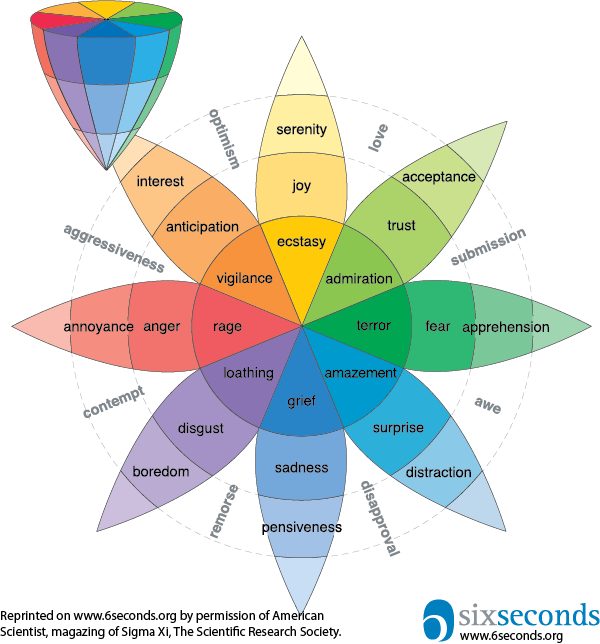
Plutchik proposed a model of eight basic emotions that each has a physiological response.  He said that each of these could be more or less intense, and they could combine.  They are portrayed as opposites because they provoke opposite physiological responses:

 There are many different ways of defining emotions, but researchers in this “adaptive” tradition tend to see that these basic physiological responses each serves a different survival need and (a) focuses our attention to a threat or opportunity, and (b) motivates a response.


Emotions Are Signals

Anger, for example, is a signal that our pathway is blocked.  We want to be promoted, we perceive someone is interfering with that, we are angry at the person.  The anger serves to focus our attention on the threat and motivates a response of fighting or pushing through the obstacle.

Here is a chart of the eight basic emotions and a likely description of the focus and motivation provided:

We can use this table to “decode” our emotional experiences. It shows us that emotions serve a purpose, that there is value in all feelings.  But it’s still easy to say that some are “negative” because they’re tied to problems or threats.

We can try to remove the judgment and call some of these “pleasant” or “unpleasant,” but that doesn’t quite work:  Sometimes when I think my son is defying me, it feels very pleasant to express my anger.  When my dad died, it felt right (not exactly pleasant, but good-hard) to feel sad.

Another approach is to characterize them as “contracting” versus “expanding.”  Feelings tied to problems narrow our attention and cause use to zero-in on the issues, to slow us down, to restrict our risks.  At the other end, some feelings energize us to look outward, to become more open, and to take risks.  Of all the “polar” characterizations this is my preference because it’s genuinely non-judgmental.  However, I’d like to go a step further.

In Buddhism, and many other faith traditions, there is a notion of “non-duality.”  Rather than good and bad as opposites, they can be seen as one, a whole with balancing sides.  This is visually represented in the yin-yang symbol.  In that graphic, the universe (a circle) is half and half… but not actually divided.  The black and white are interlocked – they are one circle with two aspects.


Could we take a non-dualistic view of emotion?

Rather than characterizing feelings as opposites (good/bad, pleasant/unpleasant, contracting/expanding), is there a way to see them as a linked whole?  Often people in my work describe emotions on a continuum – a spectrum from one extreme to another, taking an emotion and it’s opposite as ends of the number line.  This has some merit because we’re starting to link them as part of a whole, but it’s still dualistic:  There are positive and negative integers on the number line.

Let’s go back to the definition of anger:  You feel angry when you want to go someplace, but your way is blocked.

So anger arises from that sense of an obstacle. What, then, could we call that feeling of “wanting to go someplace”?  Perhaps anticipation?  Or maybe commitment is a more powerful version of that word?

In that case, we could say that there is actually no such thing as anger without commitment: If you don’t want to go anywhere, you won’t get angry!  In other words, they are not two separate things:  Anger only exists in contrast, in balance, in context of commitment.

How about fear?  Fear is a message of potential threat – a signal that something you care about is at risk… so if you don’t care, you won’t feel fear.  In other words, fear and caring (aka love) are also a non-duality.

Sorrow arises when you are losing someone or something that matters – a meaningful relationship, a significant person.  But when we feel that sense of meaning and significance, we experience it as joy.

Finally, disgust is a signal of violation.  It means rules are broken, agreements at risk, the systems and structures of relationship are in peril.  Yet if we did not feel trust in those very same things, if they did not signal a sense of safety and balance, then we wouldn’t care if they were imperiled.


Are They Really Opposites?

At this point, I’m fairly content with a hypothesis of these constructs – not as opposites, but as wholes.  The dark and the light of the candle, but there’s still something missing.

I’ve been thinking about this problem for several years, and recently I heard an idea that I’d like to consider.  I was privileged to be on a panel with Dan Shapiro, a professor at Harvard Law & Medical Schools, and the co-author of Beyond Reason: Using Emotions as You Negotiate.  The conference was on emotional and spiritual intelligence in negotiation at Harvard Law School.

In describing the challenge of first identifying – and then actually dealing with emotions in the complex dance of negotiation, Dan’s succinct summary:  “It’s really tough!”  So his proposal is to notice emotion, but to go to a deeper question:  What’s the basic need driving the emotion?  Since there are a relatively small number of basic needs, perhaps five, it may be easier to handle this set.  If we can attend to these five basic needs, Shapiro’s compelling case is that it’s far more likely that a true negotiation will arise.


Emotions:  It’s Really Tough!

Typically when talking about basic needs, the premise is that a whole range of emotions will surface in response to a need being met or not met.  In Nonviolent Communication, Marshall Rosenberg and colleagues have done wonderful work illustrating these dynamics.  Hearing Shapiro use basic needs as a way of explaining the emotional dynamics of negotiation, I wondered if we could look at the “emotional non-dualities” through this lens:

Anger-Commitment is tied to wanting to move, a need to achieve. It’s pretty easy to see that this emotion-pair arises in conjunction with a basic need that could be called accomplishment.

When we feel Disgust-Trust, it means the social contract that produces order is vulnerable (this contract can be within ourselves, and when we violate our own precepts we feel disgust turned inward).  While fear also signals risk, it’s not usually tied to the contract but to the human implication. And it’s trust that signals safety; so perhaps the specific surety of trust balances with a specific peril of disgust, in which case this construct is tied to the basic need of safety.

While the Fear-Love dynamic can arise a connection with an inanimate object (fear of losing a home), I suspect it’s most deeply rooted in a desire to nourish others, to be in a balance or harmony.  To be connected. This could be called the need for belonging.

Again, the Sorrow-Joy dynamic seems to arise in a range of situations, but I’ve been thinking about the biology of joy.  Joy is produced by opiates that are absorbed in many parts of the brain, but especially in the frontal cortex, the seat of evaluation.  This is an intriguing pairing because it implies that somehow when we truly understand, we’ll  get the reward of inner bliss.  We could call that pursuit of meaning the need for purpose.


Three Key Messages About Emotions

It’s likely that in our day-to-day lives, there are more basic needs than these, and certainly many, many “wants.”  The needs and wants are tied to a big range of feelings.  But perhaps if we can distill down to a simple level, the complexity of our feelings becomes easier to understand – and to manage.  While I’m uncertain if these labels are wholly adequate, there are three key messages that I hope you’ll take away:

1. Emotions are signals that serve a function.  They should not be “blindly obeyed,” but nor should they be ignored.

2. There is an innate connection between needs and emotions.  In trying to make sense of your own or another’s feelings, consider that they might be signals about a core need.

3. Although feelings can be uncomfortable and overwhelming, resist the urge to judge them – and to judge yourself and others for having them.  Instead, consider that each feeling is part of a larger story, a story of what’s truly most important.


Thank you to Ayman Sawaf for sharing Lazarus’ work and explaining that emotions come in pairs, to David Caruso for teaching me about the adaptive value of feelings, and to Dan Shapiro for the thinking about needs.

Joshua Freedman

Joshua is one of the world’s preeminent experts on developing emotional intelligence to improve performance. With warmth and authenticity, he translates leading-edge science into practical, applicable terms that improve the quality of workplace relationships to unlock enduring success. Joshua leads the world’s largest network of emotional intelligence practitioners and researchers.
See 249 more posts by Joshua Freedman

  48 Responses to “Integrated Emotions: Rethinking the way we evaluate our feelings”

  1. I like to think of emotions as the “smoke alarm for my building” (I’ve probably borrowed that from somewhere!) They deliver a message we’re supposed to take note of. Your article elaborates on what that message might be. I thoroughly enjoyed this article and the “discussion” within the text.Thank you!

  2. hi Joshua,
    Really liked your article and the distinction you are making . I have a strong belief that god bad are not feelings but judgements . Personally my anger has been a very facilitative emotion to go deeper , like a spiral it opens new doors . You have captured the process well and in simple terms . I am with you in your articulation . This is how I have been facilitating my labs but you are giving words in a systematic fashion to something that is innate in me .
    Thank you .
    Wanted to attend your certification in Mumbai this time but am facilitating something in Hungary and return on 19th only . Let’s see .
    Warmly,
    Sushma

    • Hi Sushma – I agree with you – “good” is not a feeling. “bad” is not a feeling. They’re shortcuts we’re using, and if we could notice that in ourselves I think we could be a lot more emotionally intelligent.
      I hope it works out for you to join us in Mumbai in September — but if not, I’ll look forward to the next one.
      - J

  3. Speaking from experience, handling emotions that is stress-related is more difficult than emotions that is an expression of joy, elations, pride. I just re-frame the situation that caused the emotion…situate it in a bigger perspective…allow the emotion to be expressed for awhile, but not to be over-whelmed or stuck up in that state. My ability to ‘take control’ i think has been influenced by my upbringing, where my parents and grandparents ‘checked’ us when we were either too happy or too sad…or stayed in whatever emotional state ‘too’ long for comfort. We were always reminded that life had to go on – irrespective of situations and just ‘embrace’ the moment only for the moment. We were always reminded of the reality of death and that we were passers-by and to just experience a situation as another lesson in life. While this perspective allowed me to move on, i now realize, that i think i have never felt what it is to be blissfully happy (which makes me a little sad) on the other hand, it has made me a strong person, moving on irrespective of the heaviness of a problem. In other words, it is rare that I fight a problem….either i solve it or let it go. Certainly, it needs wisdom to decide when exactly is the right time to let go. I pray a lot for wisdom…share my situation with trusted friends and get their opinion…clarify my mind and try to be at peace before i decide to let go of a situation.
    Certainly one has to reach a certain point of maturity to be able to decide with wisdom and grace.

    • I agree Neri – as stress increases we’re more likely to be reactive. That’s the purpose of stress… but the problems we need to solve are rarely solved with a fight-flee-freeze approach. I love the idea of reaching the level of maturity where I can engage in these moments with wisdom and grace, and I am not there yet… but I’m finding great value in being a “work in process.”
      Thanks for sharing.

  4. Hi Joshua, this is fabulous material, thank you so much for your continued efforts to help us all become more emotionally intelligent. Your article is the absolute best/closest answer to this most intriguing of subjects & of enormous importance to our lives & the way ‘we’ all live them. Yes, I find it so necessary to come up with a ‘name’ for this & so many other matters in this our new evolved & evolving awareness & understanding of emotional intelligence. I have found people ‘use different’ language/words specific…and I find mytself having to ‘ask’ ” and what exactly do YOU mean when you say ‘that’…as there is no universal words to be used as yet. Come on Joshua you will have to invent a new language ha ha! I will joyously await that (non-dualistically of course). Wellness to all, Julie.

    • Hi Julie! Aren’t words fascinating? I am so intrigued by the whole range of emotion and meaning we can attach to them — and then as we use the words we’re, often unintentionally, reinforcing that meaning for ourselves and others. :)

  5. typo – first sentence, “…what(?) does it happen?”

    I love the whole concept and your writings have helped me over the years. Thanks.

  6. Reflection: Perhaps happiness is the ability to recognise all states and to be with them. From being with yourself and your emotions, you give yourself the awarness and energy to help you learn and grow. Rather than ignoring or suppressing your emotions which inhibits learning and growth. Maybe this is happiness, then again maybe it isn’t, maybe happiness is a state of nonjugdement and nonattatchment and maybe our emotions let us know when we are judging and being to attached to people, things and beliefs. Maybe we just can’t put a label on it, maybe happines just is.

    • Hi Kristy – it seems that the current trend is to “chase” happiness. In your reflection I see the idea that happiness would come only when we stop chasing and engage in the range of our present emotions, even the difficult ones become part of happiness?
      Thank you!

  7. Hi Josh, this is a wonderfully thought provoking article. Thank you. Dan Shapiro’s insight about decoding the need driving the emotion is similar to the Six Seconds question “what do I really want”? As we consider the story behind the emotion, I wonder if there is another step for us to determine whether the emotion is aiding or hindering the achievement of that need and then, a choice about whether we “let it go” or not?

    • That’s awesome Melissa – because emotions are not just “adaptive” for survival, but in what you describe we take it a step higher from “survive.” Actually leveraging this data to achieve purpose.
      I guess, as I mentioned to Mervyn above, sometimes “in the heat” of intense feelings, I have a hard time stepping back, so this kind of “quick check” will be helpful.
      Thanks for this important comment.

  8. Joshua
    This is a very inspiring work of yours, thank you for sharing! I too have been thinking about ‘events’ in this way. Events we judge as good or bad, producing emotions that are related to how we judge events. What if I just decided that events were just…events? Neither good nor bad. How would I react then? This train of thought is easier to write than to live! I still react to events as good or bad when I am unthinking, however when I purposely think about events, then I can practice non-judging them.

    • Hi Mervyn – I love that – it’s about stepping back and saying, “ah, interesting.” I had several challenging conversations yesterday and I did not succeed at this practice, but I’m recommitted today to see these events in the way you described – thank you!
      I’d say that “feeling” arise from the combination of the perception, the emotion, and our thinking about those things. And, that it’s non-linear. Thoughts create feelings create actions… AND feelings create thoughts… and actions create feelings… etc — it’s a dynamic, continuous system rather than a simple linear sequence. :)
      - J

  9. Joshua, great article and excellent food for thought. I like the idea of using emotions to identify needs as well as the concept of emotions being on a continuum. There is much to be learned from our emotions though I think for me the challenge is to slow down and reflect and to be more aware of my own emotions. It’s not that I am ignoring them, it is that life is so busy it is easy to forget about them. When I do tune in to my emotions, I find that I have many emotions going on at the same time.
    Thanks, Anthony

    • Hi Anthony – I agree. I get so caught up in DOING that sometimes I miss the point… I guess that’s a major motivation for me to write, because it pushes me to observe and engage in a different way.

  10. Hi Josh,

    This is an excellent piece of writing. I think it may be the best I have seen for talking about a very difficult concept, i.e., identifying all emotions as valuable rather than positive or negative. For me, there is one part that does not work and that is the last section tying emotion to needs. It is confusing in part because you include Plutchik’s model and than offer anger commitment and fear love as items from someone else’s model. More importantly though I think you already have a helpful way of thinking about emotion by introducing your earlier chart that deals with motivation for emotions. Instead of introducing Shapiro and needs consider building on your ideas of motivation behind emotions. Overall very well done and if you don’t mind I would like to use your article in my work when the occasion arises. By the way you may consider using the word valuable in holistically describing all emotions. That is what I have been doing when I address the idea that people want to do away with negative emotions.

    Warm regards,
    Chuck

    • Thanks Chuck – I like Plutchik’s “pairs” too, and my sense is that they’re still in the concept of “opposites” — not single entities. So on his model where fear and anger are on one continuum, they’re both tied to a problem, which is why I’m moving away from that.
      I’d be honored to have you share the article when it’s valuable.
      Warmly,
      - Josh

  11. What’s a beautiful written piece – to challenge us to go deeper into our emotions – understand the duality of emotions and how it ties to needs.

    Josh, as always, appreciate your depth of insights.

    Angie Wong

  12. Josh,
    I continue to be inspired by your dedication to EI. It IS really tough to work with our emotions and very hard to teach this material. In my own life, I’m struck by the need to “endure” emotions that seem irrational until the “move through me.”

    • Hi Laura – maybe it would be helpful to reframe this – rather than “endure” could it be “observe”? :)

  13. typo: you wrote “contact”, im sure you meant “contract”…
    “When we feel Disgust-Trust, it means the social contract that produces order is vulnerable (this contact can be within ourselves, and when we violate our own precepts we feel disgust turned inward). While fear also signals risk, it’s not usually tied to the contract but to the human implication. And it’s trust that signals safety; so perhaps the specific surety of trust balances with a specific peril of disgust, in which case this construct is tied to the basic need of safety.”

  14. Really long post, read at your own risk, and do not operate heavy equipment while doing so. :)

    Your article makes a lot of sense, and as a proponent of NVC and their articulation of needs and how needs impact our lives and conversations, the direction of your article resonates with me. Emotions as a continuum…..paying attention to what our emotions are signaling for us…..decoding, and so forth all are in the arena for better self understanding and building emotional intelligence within.
    At the same time, practically speaking, our discussions are cognitive, and as such when we meet with and discuss with others to educate and “enroll”, the cognitive approach alone may not be enough. I sense that when you tell your own stories you are working to include the emotional foundation for these discussions. A useful approach—and perhaps still not quite enough to make breakthroughs. (I’m not saying that we shouldn’t take this approach, it is very effective and I’ve used it to make things more human, more real.)

    Certainly, the learning methodology that Six Seconds models is another piece of the puzzle toward educating, “enrolling”, and helping others make their own breakthroughs. And maybe there’s more…
    I have been working for the past six months with the majority of our leaders (managers and supervisors) using Six Seconds DHP Leadership modules. This has been an enlightening experience. Not only have I become more adept at the learning methodology, I have noticed the incremental changes that have happened with the folks, each at their own pace, and some not much at all. To expect dramatic transformation in a short period of time isn’t realistic in our environment where many of these folks have been imbedded in a very specific culture for years (15 – 30 years plus). Still, I am encouraged.

    Consider this then. If these folks move slowly toward greater effectiveness and greater emotional intelligence in this culture, imagine the magnitude of the task with the human experience of working with adults many of whom have grown up with familial, social and cultural influences for the majority of the totality of their life experience. A mouthful, but you get the drift, hopefully.

    And today, we are in the “speed”/overload zone. Get your message out their quickly or you lose me—the less than 30 seconds Elevator Speech. By the way, I don’t really think we are really living EQ if try to reduce it to that, yet that’s the challenge.

    What I’ve also noticed in working with leaders in our organization with the modules, is that they seem to “get it” and really want to apply their insights and new tools—but have difficulty doing so. And, I don’t think it’s a skill set, practice issue. It feels like it’s more of the emotional barriers and patterns that became inculcated over their breadth of life experience. The Synapse School is starting at an early age with children so that more effective patterns and relationships with emotions are cultivated. What now for adults?

    All of the above moves us in a productive direction, but is there something else that needs to be added in, some deeper (without being psychoanalytic) way of helping folks make the breakthroughs?
    Perhaps Josh and some of the other Six Seconds and EQ learners who have been at it for a while, might be able to look at their own journey and what were the breakthrough moments they experience, and what seemed to trigger or at least be helpful in that happening. Maybe there are some clues there. And sharing that with this network might help us all be more effective in helping others (and ourselves as it seems to be a life journey).

    Here’s one thought (without much thought…more intuitive):

     Share a personal insight from when you were a child. For example, “I used to get so mad, or cry when kids would call me names and tease me. My mother would try to help by saying ‘Sticks and stones may break my bones but names will never hurt me.’ But it did hurt. I had a very loving mother, and sometimes when she tried to help, it made it worse. Like when I was petrified of the water, when everyone else in my family was a swimmer, and she said, ‘You don’t need to be afraid, everyone can float and learn to swim. It’s fun.’ Not so much.”

     Then ask a question. “Anyone else have something like that when they were a kid?”

     Ask, “How did it feel?”

     Ask, “And what did you do then?”

     Ask, “Would you like to have done something different—what would have helped?”

     Show appreciation for their sharing.

     Share an adult experience involving emotions, and how it impacted what you did. Then relate it back to what you learned as a child without giving any solution of how you are much wiser and made better choices now. If you did make a better choice, save that revelation for later in the conversation. Your goal here is to invite the other person(s) into sharing in a safe place.

     Invite them in by asking the question, “Does anyone here have something like this that happened recently?”

     Ask, “How did it feel?”

     Ask, “And what did you do then?”

     Ask, “Would you like to have done something different—what would have helped?”

     Show appreciation for their sharing.

    Now you have a real connection to emotions and how they impact each of us. Then you can seque with a statement that introduces Emotional Intelligence in whatever fashion you might want to. For me, it might look like: “So in these situations, either as a child, or right now, as adults, emotions are to some degree or another, always present. When it works for us (refer back to a “good” story someone told), emotions are working for us. When it doesn’t work out so well, emotions are not working for us. Emotional Intelligence is about including emotional information in our lives in ways that improve the quality of our lives, and our effectiveness with others. We make better choices.”
    All of the above is stream of consciousness stuff and perhaps not very good, but it suggests a direction that might make the topic more real and accessible.
    Just for sake of argument, whether you do something like this or some approach that you have found works, the next challenge is to help people to be conscious of the difference between talking and sharing about EQ, and applying it after they leave. In the DHP modules, there is always an Action Plan and Reflection component. For people who embrace that and follow through, I have no doubt that this is very effective. The question I grapple with is “So what gets in the way of feeling comfortable with sharing and role playing in the session, yet not wanting to look at a real life application that faces them after they leave.

    I’ll end with an example of this. I’m not looking for solutions, I have my own thoughts and avenues, but I want to illustrate with a real situation. Here it is.

    Woven through the DHP modules is the Six Seconds Model. We have had incredibly useful and insightful exercises, experiences and insights on trust, empathy, motivation, and more….
    I recently met with two large employee groups to do a post review of a major organizational change. In a word, they were very distressed. Lots of issues. The headline is: “Our management doesn’t listen and doesn’t care.” When asked if they wanted their management to know of their issues, they had two concerns: “Will we be retaliated against?,”and “Will it even make a difference?”

    Our group of leaders, who in our sessions has not only grasped the power of emotions, but who also has expressed their own emotions, stress, frustrations, etc., and who has also identified their best practices in building trust, managing change, etc. is very reluctant to do the one thing that the group most wants: to listen and show you care.

    Clearly, there are some barriers to “taking this on the road” and applying it to a very real situation. They would rather hope that it “dies down, and goes away.”

    I do have thoughts on this, and we’re going to deal with it, but I do think that this illustrates the depth of emotional patterns and barriers…and needs that present challenges in our work.
    More than enough said………

    • Worth the read Allen, thanks for sharing this. I’d like to respond to 3 elements briefly:
      1) Change is easy, but it’s hard because there is so much of it to do. As you wrote, there are just so many threads in the fabric of “the way things are.”
      2) This is why the approach you’re taking with the Developing Human Performance curriculum is so important — rather than a workshop, you’re creating a learning process — as you wrote, over these last months you’re starting to see this sinking in!
      3) I appreciate the sequence of questions you’re articulating. I see this as very “Self-Science-like” in the way we encourage people to draw from their own experience, notice the choices they’ve made and why — and then consider if they might have other options that would move them toward their real goals?
      Keep rocking the boat, my friend.

  15. This is incredible stuff !! Written with somuch of clarity.Thank you so much Josh for this one.I liked the way you explained emotions as Focus and Motivation perspectives and also about anger-commitment nonduality.This inspiring article with deeper understanding, will guide all of us to reach out to others with even more clarity.This in turn will help many to reach out to the “Ecosystem’ (the 85% of our iceberg) of our body-mind,which is absolute necessity for effective and optimal performance,

  16. wonderful article and whole new perspective. Is it possible to make a table of five columns need – want – emotion – situation – Best possible response. I know I am trying to simplify it but without this kind of ready to use tool, it will be very difficult for a common man to benefit from this knowledge base.

    • What a powerful idea Parag. I think it is over-simplifying, but we could say “this is an example” (not “this is the complete story”) — and this becomes an exercise for all of us. At Six Seconds, our approach would normally be to add very important ? mark to the end:
      need – want – emotion – situation – best possible response?

      I do think it’s useful to offer examples and stories — AND it’s essential that we encourage people to find their solutions… because the truth is that my solutions “sort of work” for me, they’re unlikely to work for everyone. :)

  17. Thanks Joshua!
    This actually came at perfect timing. I am writing a lesson plan for high school students about worker safety and I’m teaching them skills in emotional intelligence. This relates perfectly well to how I am trying to teach them to become emotionally literate of the feeling of fear to help them recognize hazards at the workplace and learn how to effectively deal with them. Your idea of approaching all feelings as neither good nor bad, but simply beneficial to understanding ourselves is exactly the piece I needed to add in. I was having a hard time describing how emotions are important to us to provide an understanding of ourselves without much reasoning and how intuition can be a great thing if we focused on it more.
    I am so happy for you work and effort into EI.
    Sincerely,
    Kari

  18. My Director of Organizational Development directed me to this article. I particularly found it interesting that you chose Buddhism as a lens with which to view what is a symbiosis rather than dichotomy. I’m very interested in exploring the connections between positive psychology and Zen so your venture in a similar direction certainly helped draw me in. I think you make an excellent point.

    My main question for you however is regarding anger. Do you consider it an obstacle when someone insults you and you get angry? What path are they blocking? And to what degree is the anger the fault of the person insulting you and to what degree a reaction that we should own. (As in those who say, “I didn’t make you angry, you let yourself get angry at me.”)

    • Hi Morgan – I appreciate both your questions about anger. I don’t know.
      My first response is:
      – If someone insults me, I feel angry because there is something I want (someplace I want to go, not literally, but in terms of relationship). I spoke to someone yesterday who I found to be subtly and consistently insulting to me — if I genuinely didn’t care, it wouldn’t have mattered to me. However, I wanted something, I wanted to move the conversation in a particular direction… and this was definitely an obstacle for me to navigate… and in this case, I chose to put the anger aside and consider it later to become clear what it was that I was really feeling. Maybe a combination of fear, hurt, and disgust — which was bubbling together with the anger.

      – People are social beings. We are wired to connect. So, it’s not “optional” that we respond emotionally to one another. It’s immediate and visceral. So, I’d say
      a) setup — we’re in a state, which we’ve chosen. Maybe calm and collected, maybe frazzled.
      b) trigger — someone says something
      c) interpretation — we begin to react — automatically, and also we start to make meaning of it.
      d) reaction — we continue to define the meaning, and this shapes how the reaction unfolds.
      e) escalation (or not) — we keep processing the data, and either we continue to “go up the ladder” or choose to get off.
      This point is now part of the next time around the cycle. We call this the Reaction Cycle and we have a tool called the Reaction Roadmap — I hope to write more about it soon.

      If this perspective is interesting, have a look at this article that I wrote for children about this: http://www.6seconds.org/2010/09/15/smarter-about-feelings/ — check out the little section called “Emotions as Messages”

      Warmly,
      - Josh

      • A very interesting and thoughtful article Josh and fascinating replies – thank you.

        As part of my work with individual clients and organisations I readily use the concept of EI. It also plays a part in my life in a broader social sense – through the civic and voluntary organisations I belong to. and the issues they address. I am interested in it’s place in the education system too – so too much to say, and too many questions for this reply!

        So just a few comments and questions.

        How would you place ‘rage’ or ‘outrage’ as opposed to anger in your schema Josh?

        In answer to one of the replies – when ‘talking’ about emotional intelligence is not working, (eg: a manager has an anger issue, understands the concepts of emotional intelligence but fails to apply them in the workplace) I have found that trance work and ‘time line’ work (going to earlier states, often childhood, where the emotion is present and then forward to the adult state to inform the past with the present maturity and visa versa) can be effective. Visualisations in trance can also help – visualised role playing or visual or spoken metaphors.

        I am interested in how emotions work in larger groups or populations and how much is influenced by a group past history and events? What role do ‘expectations’ play in the emotional response of a group? What is instinctive and what is learnt? (One of the respondents talks about how they were taught to exert ‘self control’ for example, an expectation of behaviour was imposed upon the emotion). What is the possible range of connections between emotion and behaviour?

        Most humans are very good at identifying emotional responses in others, before any words are uttered. We then often use ‘words’ to react to or negotiate our way through that response, at which point what we say and how we say it becomes important. It is not just our own emotions that we need to be aware of and thoughtful about but how we process and then react to the emotions of other people.

        I think your comments on parents and children are pertinent Josh and all of us parents could benefit from some ‘parenting’ seminars from time to time.

        I know of someone who has developed an excellent programme around the concepts of EI with children, how to recognise and use the emotions one feels as a parent as a means to helping the child develop. One example she gives is if your (older) child tells you they are going backpacking around Thailand and your reaction is immediately one of fear and anguish, rather than saying ‘no you are not, it is too dangerous’ to be able to recognise that it is natural to want to keep one’s child safe, but also natural to want them to grow and experience life in order to arm them against dangers in the future, so keeping them safe.

        One can discuss ways to mitigate the dangerous aspects of the enterprise without having to veto the entire project. In other words one can respect the emotional response one has as a parent but recognise it as a signal that one is at a border of development for the child, one which they may need help navigating their way along.

        Lorraine

        • Thanks Lorraine, intriguing points. “Rage” is probably a feeling that combines anger with some other things, including a judgment that “I’m right and you’re wrong” and probably fear as well — it focuses our attention on the enemy and motivates us to destroy. It’s still tied to a need to accomplish, and a decision that the only way to accomplish what we want is to destroy the other. Which is unlikely to be the objective truth, but sometimes it feels that way!

          In your penultimate paragraph you talk about the teen who wants to go to Thailand — I’d just add that this is a beautiful example of how we actually have MULTIPLE and often paradoxical feelings at the very same time. In the article I talk about fear only existing because of the caring that we have for the child. We can be proud and excited about their maturity at the very same moment that we’re wishing we could hold them tight.

  19. Thank you! This is very interesting and useful. I am sure if I work through it, it will help me get “unstuck” from the paralyzing effect of emotions I have hitherto perceived as negative.

  20. Thank you, Josh, for sharing your gleaned insights. The beauty of our feelings is that we all have them and how we respond to them is our individual and collective growth to their oneness of purpose.

    Your analysis serves as an affirmation for me. The feeling arises; it is recognized; its source is identified; a response is chosen with the intent of bringing about harmony for self, others, and situations; the process results in an awareness of COMPASSION;

  21. I really enjoyed and benefited from this article Josh. I swear you must be reading my mind because the last few weeks you have chosen topics that are very timely for the work I am doing. Thank you so much for bringing Marshall Rosenberg’s Nonviolent Communication into the conversation. I was introduced to his teachings several years ago and just recently came back to them while creating a workshop on conflict resolution. There is such a strong connection between emotional intelligence and his philosophy, and it caused me to go back and dig deeper into how to teach others about emotional literacy and the value of feelings. In my attempt to move away from judging/labeling feelings as good or bad, I chose to use “pleasant/unpleasant” as a compromise, but it never felt quite right. Your article was able to help me realize what wasn’t feeling “right”. Don’t you just love “a-ha” moments? That’s what Six Seconds is all about!

  22. Hi. I facilitate EQ/SQ workshops for management executives where I speak about all emotions as ok without necessarily being positive or negative. The expression of anger or fear etc can be negative or positive, or their triggering beliefs may be out of place, but emotions as such are energy that needs to be managed through awareness, understanding, and appropriate expression.
    My notes on EQ are part of my notes entitled who is the captain of your boat. Sending you a link to the same

    http://www.scribd.com/doc/18752567/Who-is-the-Captain-of-Your-Boat

  23. Greetings to my friends Josh, Robyn, Sushma, Neri, Julie D., Lisa, Kristy, Melissa, Mervyn, Anthony, Charles, Angie, Laura, Alice, Allen, Sandeep, Parag, Kari, Morgan, Lorraine, Cherub, Rosiemerry, Julie B., Uday, and the rest of the Six Seconds family!

    It seems that much of the puzzle around these issues has to do with our adaptation of our language and misuse or misappropriation of our words. And then, as Josh commented, we often reinforce that inaccurate or unintentional meaning for ourselves and others. This may be what we’ve done with many of the words used in this discussion.

    As Sushma points out, “good” and “bad” are judgmental. That’s because they are ethical (moral) terms used for expressing our judgments with regard to behavior. I suspect that use of these terms was much more limited long ago, but misappropriation and over-usage has made them the most generally used evaluative and descriptive terms to commend and condemn not only behavior but most everything else we know. Many people use the terms without any intention of making a moral statement. When a person talks about eating a good banana, it is unlikely she’s trying to indicate that the banana has some moral goodness. Yet, to say the banana is “good” still has some connotation of moral goodness. A person is more likely to gain some type of benefit from eating a good banana, and more likely to not benefit (or even suffer) from eating a bad banana.

    Since, in the moral sense, all emotions are “good”, there’s little to be lost by avoiding the words “good” and “bad” with reference to emotions. It would be like abandoning the use of the words “round” and “triangular” when discussing bowling balls. Because few, if any, bowling balls are triangular (or any other shape other than round and spherical), it’s pointless to differentiate or characterize bowling balls in this way.

    The only emotions that could conceivably be termed “bad” would be those that are inappropriate for the event triggering the emotion. It is “bad” to feel glee when torturing puppies. But then, it’s not so much that the emotion is bad, but that the misappropriation of the emotion is bad. We use the words pathological and seriously mentally ill for people that frequently fall victim to inappropriate emotion. Sometimes, we even go so far as to call such persons evil.

    Laura’s word “irrational” may be more appropriate for these cases. Yet, emotions are not supposed to be rational. So, to say an emotion is “irrational” may make no sense at all (since it should never be rational). A parallel might be my calling a coffee cup irresponsible. Since I never expect a coffee cup to be responsible, saying it is irresponsible doesn’t say much. To be effective, emotions must be “pre-rational”. In short, giving up “rational” and “irrational” with respect to emotions should be easier than giving up “good” and “bad”, and no different than our giving up the terms “triangular” and “oblong” when we talk about bowling balls.

    The exception, where the use of the word “irrational” might be appropriate, would be those emotions that are too extreme (either in intensity or duration) for the situation. But it only takes a little contemplation to recognize that this is just a variation of the misappropriation of emotion discussed above. So, again, it is not the emotion that is irrational, but the misappropriation. This seems to be what Neri is alluding to. Once you’ve cognized whatever it was the emotion was meant to convey, there is not a rational need to continue feeling the emotion. A person could irrationally conjure up thoughts or engage in activities that trigger various emotions. These might somewhat accurately be called “irrational” emotions, even though it is not the emotions themselves that are irrational. These may be the emotions to which Laura is referring. Navigating emotions, applying consequential thinking, and practicing optimism (and other rational thought/action) are good antidotes for these emotions.

    I think the use of the terms “positive” and “negative” is another misappropriation – this time of mathematical terms. Perhaps the usage is an effort to shirk the moral judgment required when using “good” and “bad”. But, since emotions are not in any way mathematical, the terms are not descriptive in a mathematical sense. Perhaps the purpose for “positive” is to connote some type of gain, while “negative” is to connote some type of loss. If so, the terms hint at some truth, since we often have “positive” emotions when we gain something we need, and often have “negative” emotions when we lose something we need. However, the terms are not all that helpful.

    While I support giving up the use of the terms discussed above when characterizing or describing emotions, I think it would be extremely unwise, and downright foolish, to abandon the use of “pleasant” and “unpleasant” with respect to emotions. It is the very unpleasantness of fear, guilt, anxiety, anger and other similar emotions that make them so very essential. It is their unpleasantness that gives them value and makes them “good”. Just as physical pain (which we’re learning is processed by the brain in the same way as emotional pain) is useful precisely because it is unpleasant, so is emotional pain. If fear were not unpleasant, we’d certainly find ourselves in many more life-threatening situations.

    Likewise, it is the pleasantness of joy, ecstasy, satisfaction, and contentment that makes them valuable as emotions and as states of existence. If we gained no pleasure from these, if they were unpleasant, we would have no interest in or desire to experience them. (Though, we should keep in mind that sometimes we can get a limited amount of pleasure from generally unpleasant emotions. Josh mentioned that sometimes it feels good to feel angry. Even so, anger does affect one’s brain chemistry in not so healthful ways. And, I can assure you, that the anger is unpleasant to someone, even if not totally recognized as unpleasant by the angry person.)

    I believe we can embrace these seemingly opposite classifications of emotions (pleasant and unpleasant) without “giving in” to rigid dualism or assuming that specific emotions have polar opposites. Like emotions, the classifications can be different from each other without being opposites. A continuum or spectrum is a helpful visual. However, while it’s not strictly dualistic, it is still linear. I don’t believe pleasant or unpleasant (or much of anything) can be accurately thought of in this way.

    It seems to me that most of those emphasizing the non-dualistic nature of Buddhism are Westerners talking about Buddhism; while my (admittedly limited) reading of Buddhist literature shows the literature to be replete with dualistic language and comparisons. Frequently occurring themes include the juxtaposition of good and evil, love and hatred, compassion and selfishness, attachment and non-attachment, peace and violence, suffering and happiness, and ignorance with knowledge, wisdom, and enlightenment. Perhaps it is not the dualistic language that we should avoid. Perhaps it is dualistic thought that is to be avoided. So, while there are frequent dualistic comparisons, Buddhist literature also continually emphasizes (sometimes within the same sentence as a limiting dualism) inter-connectedness, interdependence, inter-being, limitlessness, impermanence, and inclusiveness. The person on the path to Buddha enlightenment will be keenly aware and mindful that the dualistic language is merely a tool to facilitate communication and not a true or complete reflection of reality.

    Getting back to emotions, Shapiro seems to hit truth by recognizing emotion as an indication of need. Once we can determine the basic need driving the emotion, we can then, as Allen suggests, use the emotional information in ways that improve our quality of life. Or, as Josh put it, we can leverage emotional data to achieve our purpose. But then, emotions can be tricky. We might be wise to do as Melissa suggests and “determine whether an emotion is aiding or hindering the achievement of a need”. If an emotion were hindering the attainment of something truly needed (or what we really want), it would be irrational to continue harboring the emotion (at least in that situation). Either way, we’ll want to remember that emotions are always telling us something, always working for us (unless we happen to fall into that class of pathological or seriously mentally ill). How could they not? They are us.

    Finally, I’d be neglecting my noble goal if I didn’t comment on the idea of happiness. Happiness is seen as the ideal because it is the ideal (as far as we know). The needs listed by Josh – accomplishment, safety, belonging, and purpose – are either conditions of and/or means to happiness. If any of these did not somehow contribute to our gaining happiness, we would neither need nor want these. (By the way, Maslow’s hierarchy of needs would also work for building the model.)

    Please keep in mind that I’m not talking about a fleeting emotion called happiness – the type of thing you experience when eating your favorite ice cream on a hot day. (My suspicion is that the term “happiness” has suffered the same type of abuse as have “good” and “bad”.) The happiness I am considering is a continuous and abiding state of joy which includes contentment, peace, tranquility, and even bliss with ecstasy. It is much more than an emotion. As valuable as emotions are, an emotion will never be a sufficient goal or purpose for life. Yet, the happiness of which I write is the goal of all people (explicitly or implicitly), and I believe it to be the primary, if not sole, purpose and meaning of life. That happiness is pleasurable and a means to yet more happiness makes a full explanation of this belief impracticable here. Besides, don’t you think I’ve said enough already? Suffice it to say, I think there is ample evidence provided by Eastern and Western philosophers, most (if not all) religions, and the burgeoning field of positive psychology to support the contention.

    Thank you for a richly rewarding discussion. This non-dualistic, need-based model will certainly benefit a great many as it emerges and evolves.

  24. As you might have predicted, I continued to have thoughts about this subject after my lengthy post. First, in addition to “pre-rational”, “sub-rational” and “supra-rational” might be used to describe the link between emotions and rational thought. Do any of these make more sense that the others? Also, I thought a summary of how I perceive the model might be helpful. So, here it goes.

    An unpleasant emotion is an indication that some need is not being met or is in danger of not being met in the future, while pleasant emotions are indicators that needs are being met, or are very likely to be met in the very near future. Mixed emotions might indicate some ambivalence or confusion as to whether or not one’s needs are being met. “Needs”, as used here, will also include “wants” (not critical for survival).

    Once you’ve experienced the emotion, appreciate the emotion and express gratitude to the emotion for alerting you to whatever has changed with respect to satisfaction or your needs. Find out what thought, action, and/or situation has changed, and that is prompting the emotion. The type of emotion (pleasant or unpleasant) will help you determine whether to look for needs that are not being satisfied, or whether to look for needs that are being satisfied.

    If the emotion was unpleasant, determine whether non-satisfaction has to do with a want, or with something that is needed. The concept of non-attachment may come in handy here. If it has to do with a want, consider how reasonable the want may be. If it has to do with a need, adjust your activities (if possible) to maintain satisfaction of the need. Consider whether the emotion is accurate. Is the need really in danger of being unfulfilled? If not, adjust your thoughts.

    If the emotion was pleasant, determine whether the satisfaction has to do with a want, or with something that is needed. Express gratitude and appreciate the change in need/want satisfaction accordingly. Either way, savor the experience and the satisfaction of the need.

    As a person’s empathy and compassion advance, the needs considered will extend beyond one’s own personal needs to include the needs of all persons. Perhaps, if the person is on the path to true enlightenment, this perception may extend to all sentient beings, and then everything, and then to nothing at all.

  25. Dear Mr Joshua, Your articles on emotional intelligence are useful and educative.You are doing a world of good to the readers across the globe.
    yours sincerely,
    JVL NARASIMHA RAO
    INDIA

    • Thank you Narasimha – comments like this help me want to continue! I’ve just arrived in Mumbai a few hours ago ready for an exciting 10 days of transformational EQ teaching. :)

  26. Respected Joshua Freedman,

    I value your contributions In EQ teaching and glad to read this article. Presently I am doing certification program in ICA and working on my thesis on EQ awareness . I request your permission to quote from your articles as it is stated.

    With warm regards

    V S KUMAR

    • Thank you for asking Mr. Kumar – I would be very pleased to have you do so.
      - Josh

      • Joshua Freedman,

        Sir,

        Greetings.Honoured with your prompt reply and permission. In fact I am keen in getting certified by 6seconds on EQ. Presently I am a Student of ICA. I find the fee structure is beyond my reach at present. If there are scholorship facility & other possibilities of paying it in parts, I am really willing to attend theCertification at Mumbai. I have a passion for understanding EQ and support in my Journey as a coach.

        Sir, I welcome you to India.

        With gratitude,

        V S KUMAR
        ReCreate Life. May I Assist You?

Leave a Reply