

Emotions Travel in Packs: What Your Feelings Are Really Trying to Tell You (the new Emotion Constellation Map)
Have you ever felt grief and joy at the same time?
When my father died, I had a feeling I couldn’t find on any chart. I sat on the steps with my brother, and the moment was both painful and beautiful — grief and love intertwined. It wasn’t sadness or gratitude. It was both, fully, at once. Love distilled.
I’ve spent decades studying emotion maps, wheels, and models. I love them — they’re incredibly useful for building emotional vocabulary and sorting out what we’re feeling. (If you haven’t explored Plutchik’s Wheel or the more in-depth Emotional Wisdom Wheel, they’re a great starting point.) But when my Dad died, I had a feeling that didn’t fit on any of the charts.
That experience sent me on a journey — one I share in my new book, Emotion Rules — and it led me to a discovery that has changed how I think about feelings: Emotions work as constellations.
Your Feelings Don’t Come One at a Time
Here’s something you probably already sense but may not have put into words: emotions travel in packs.
When you’re anxious about a presentation, there’s often excitement underneath. When you’re angry at someone you love, there’s usually hurt — and maybe fear of losing the connection. When you feel exhausted after a long stretch of overwork, that fatigue might be tangled up with pride, guilt, and longing for something more.
We tend to name the loudest feeling and stop there. “I’m stressed.” “I’m frustrated.” “I’m fine.” But that surface-level label is rarely the whole story.
“Emotions travel in packs.”
One of my favorite coaching questions is deceptively simple: What else are you feeling?
That question sparks emotional wisdom. It’s an invitation to look below the surface, and what you find there is almost always richer and more useful than the first feeling you noticed. (If you want the science behind why we have multiple feelings at once, I wrote about that in What Are Emotions? and the basics of how emotions, feelings, and moods connect.)
Beyond Opposites: The Constellation Model
Most emotion models organize feelings as opposites. Joy vs. sadness. Fear vs. anger. Trust vs. disgust. That binary framing is tidy, and it helps our minds make sense of complexity. But as I write in Emotion Rules: “Sometimes what matters most is not choosing between feelings, but learning to hold them all.”
The reality is messier — and more interesting. When I began looking at emotions through a nondualistic lens, I noticed something surprising: feelings we call “opposites” often serve the same deeper need.
Fear and Trust? They’re not enemies. They’re both messengers of Safety — both trying to help you navigate risk and protection. Fear says watch out, something’s at stake. Trust says it’s OK, the rules are in place. Different signals, same underlying concern.
Grief and Love? Both are messengers of Belonging. Grief tells you that connection mattered deeply. Love tells you the connection is alive. They’re not opposites — they’re companions, two sides of the same longing.
I call these “fellow messengers.” And once you start seeing emotions this way, the packs become visible. That mix of feelings you couldn’t untangle? It starts to make sense — not because you’ve sorted each feeling into a box, but because you can see the shared need they’re all pointing toward.
As I write in Emotion Rules – The Science & Practice of Emotional Wisdom: “When we stop fighting for one emotion to win and instead allow all of them to belong, we find something richer than relief. We find meaning.”
Seeing the Constellations
Think about stars in the night sky. Individually, they’re just points of light. But when you see the patterns — the constellations — they help you navigate. That’s how I came to call this framework the “Emotion Constellation.” Your emotions follow patterns, like stars in the sky, and those patterns can give you direction.
I built an interactive tool to make these constellations visible and explorable.
“Fear and Trust aren’t enemies — they’re both messengers of Safety.”
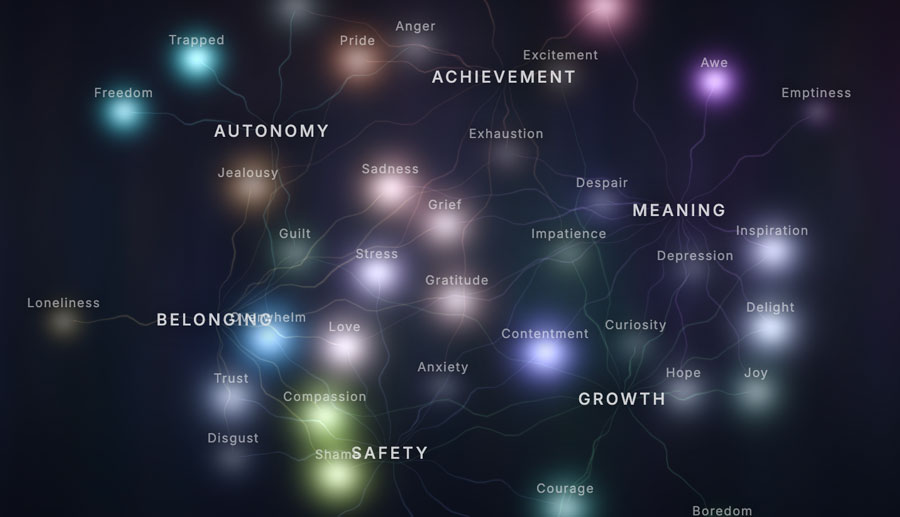
You can click on any emotion — say, Exhaustion — and watch its connections light up. Exhaustion doesn’t just connect to one need. It reaches toward Achievement (are you pushing too hard?), Safety (is something draining your reserves?), and Autonomy (do you feel trapped?). Suddenly, a feeling that seemed flat and obvious becomes a doorway into deeper self-understanding.
The tool also surfaces inquiry questions — prompts like “What would it mean to let go of the need to prove yourself?” or “Where in your life do you feel most free?” These are the kinds of questions that turn emotional awareness into emotional wisdom.
Try This: Three Steps to Explore Your Emotional Constellation
Next time you notice a strong feeling, try this practice:
1. Name the loudest feeling. Don’t overthink it. Anxious. Angry. Stuck. Grateful. Whatever word comes first is your starting point.
2. Ask: What else am I feeling? Sit with it for a moment. There’s almost always something underneath or alongside the first emotion. Maybe your anger has sadness in it. Maybe your excitement is laced with fear. Let the pack reveal itself.
3. Look for the shared need. What do these feelings have in common? Are they all pointing toward a need for safety? Belonging? Meaning? Autonomy? When you find the need, you’ve found theconstellation — and with it, a much clearer sense of what matters to you right now.
“Your emotions follow patterns, like stars in the sky, and those patterns can give you direction.”
If You Work with Others
If you’re a coach, educator, therapist, or leader — anyone who sits with other people’s emotions — this reframe is powerful. Instead of trying to help someone “fix” what they’re feeling, you can get curious about the whole constellation: What else is here? What need might these feelings share?
That shift — from solving to exploring — often unlocks the insight your client / colleague / friend / student was circling around but couldn’t quite reach. It moves the conversation from the surface to the source.
An Invitation
Emotions aren’t problems to solve. As I’ve come to see it, they’re “a map, a mirror, a source of wisdom.” The more willing you are to explore the full constellation — not just the single brightest star — the more that wisdom becomes available to you.
If you’d like to explore this further, please try the free Emotion Constellation tool. And for the full framework — the science, the stories, and the practices — Emotion Rules is available now.
What constellation are you noticing in your life right now?
Download your free guide to Handle Emotions with Wisdom
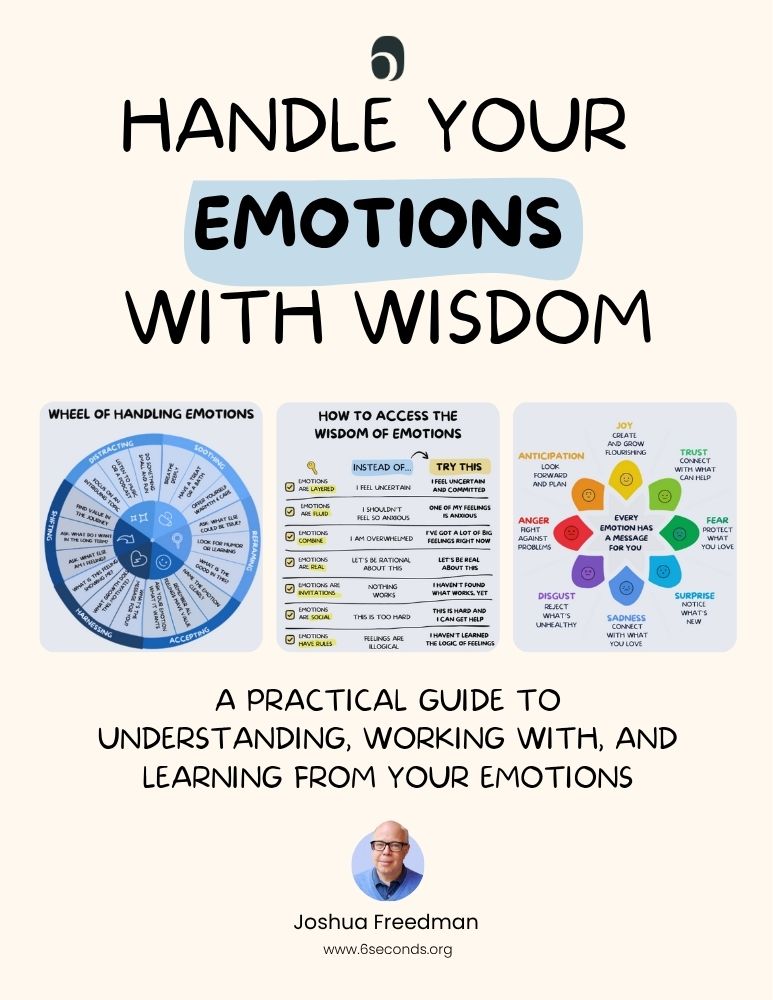
Get your free guide to handling diffcult emotiions by filling in this form; it includes 18 strategies, 7 tips for accessing the wisdom of emotions, and one of my favorite frameworks for understanding the meaning of emotions.
“The question that unlocks everything: What else are you feeling?”
For more on how to understand and use emotions, I recommend:
Learn the essential of emotions
