


The Holidays Can Be Something We Make, Not Something We Survive
by Patty Freedman
Both my parents and my husband’s parents are divorced, so when our kids were little we’d load up the minivan with everything: wrapped gifts, stockings, all the treats and baking for our four (!) holiday potlucks, overnight bags, and the portacrib, then head out for a multi-night holiday extravaganza.
I both loved and loathed the holidays. I enjoyed seeing family and friends and being together. Making memories with our kids was precious time together. But I also felt stretched thin by all the logistics, expectations, and the emotionally charged social interactions and (mis)communications. Year after year we’d make it back home overstuffed, overtired, and overwrought. Holidays could be horrible.
Looking back, I can see how much stress and emotional labor I carried through those years. I wish I’d had something to help me take better care of myself and manage the season with more ease.
A Blue Christmas?
Holidays still stir up a lot of feelings for me. Some sweet, some bitter. Probably the same for you. I used to think I just had to push through it, but that never made anything easier. Research from the APA shows that five times as many people say their stress increases during the holidays compared to those who say it decreases. A NAMI survey found that about 75% of people say the holidays contribute to feeling sad or dissatisfied, 68% feel financially strained, 66% experience loneliness, 63% feel too much pressure, and 57% struggle with unrealistic expectations. Johns Hopkins Medicine describes a feeling of “holiday blues” as sadness, loss, or anxiety tied to stress, missing loved ones, or difficult memories from past holidays. And sometimes just anticipating the season can bring up big feelings.
For many people, grief sits just under the surface of the holidays or spins you out like hitting a patch of black ice. It can rise up from a person who isn’t here, or from the way life has shifted, or from memories that pull at you. When the world insists on yuletide cheer and mistletoe, that contrast can hurt. A study in 2011 on “The Christmas Effect on Psychopathology” examined patients evaluated in a psychiatric emergency service during the Christmas season. The most common stressors reported by this cohort were loneliness (40%) and being without family (38%). The season doesn’t soften grief. It can rub salt into it.

(Not) the most wonderful time of the year
I don’t think it matters how old you are, the holidays are part of our system. Celebrating is one of the ways families shape identity. You grow up absorbing the rituals and rhythms of your household, unspoken rules, expectations, a sense of “this is how it’s supposed to be.” As we get older and form our own families, we stitch together scraps of what we inherited into something we can actually live with.
As a child of divorce, Christmas was a complicated time. I’d shuttle between two households, carrying the bottomless grief of my mother when she handed us off in the afternoon to open gifts at my dad’s house. The excitement I felt about the holidays was always tempered by sadness, knowing she’d be alone. Sometimes just anticipating that goodbye on Christmas morning was enough to make my stomach hurt. I felt pressure to be cheerful, to LOVE my gifts, to show gratitude, to be extra-helpful, an invisible performance that I danced though the hurt.
When I became a parent, I worked hard to create new holiday experiences with my husband for our children. We made things by hand. We donated. We practiced acts of service. We baked and decorated and sang and went on outdoor adventures. We added Jewish celebrations of light in the darkness, filling the windows with candles for eight nights, making latkes and applesauce. I wanted our kids to feel the magic of the season without the heaviness I carried.
I learned holiday-anxiety patterns aren’t fixed. I make choices now that serve me better. But still, when I’m back with my nuclear family, it’s so easy to fall into old roles. Even now, an adult with adult children of my own, I can feel resentful of those expectations.

Like a Sugar Cookie
The holidays act like emotional mirrors. They reflect what we were taught, what we longed for, what we lost, and what we still hope will feel different. Like a glittering sugar cookie, they’re rolled out and cut from memory and culture, baked into us long before we ever questioned any of it. We’re taught to expect an emotional script — anticipation, delight, harmony, joy — like a treat that rarely matches our lived experience.
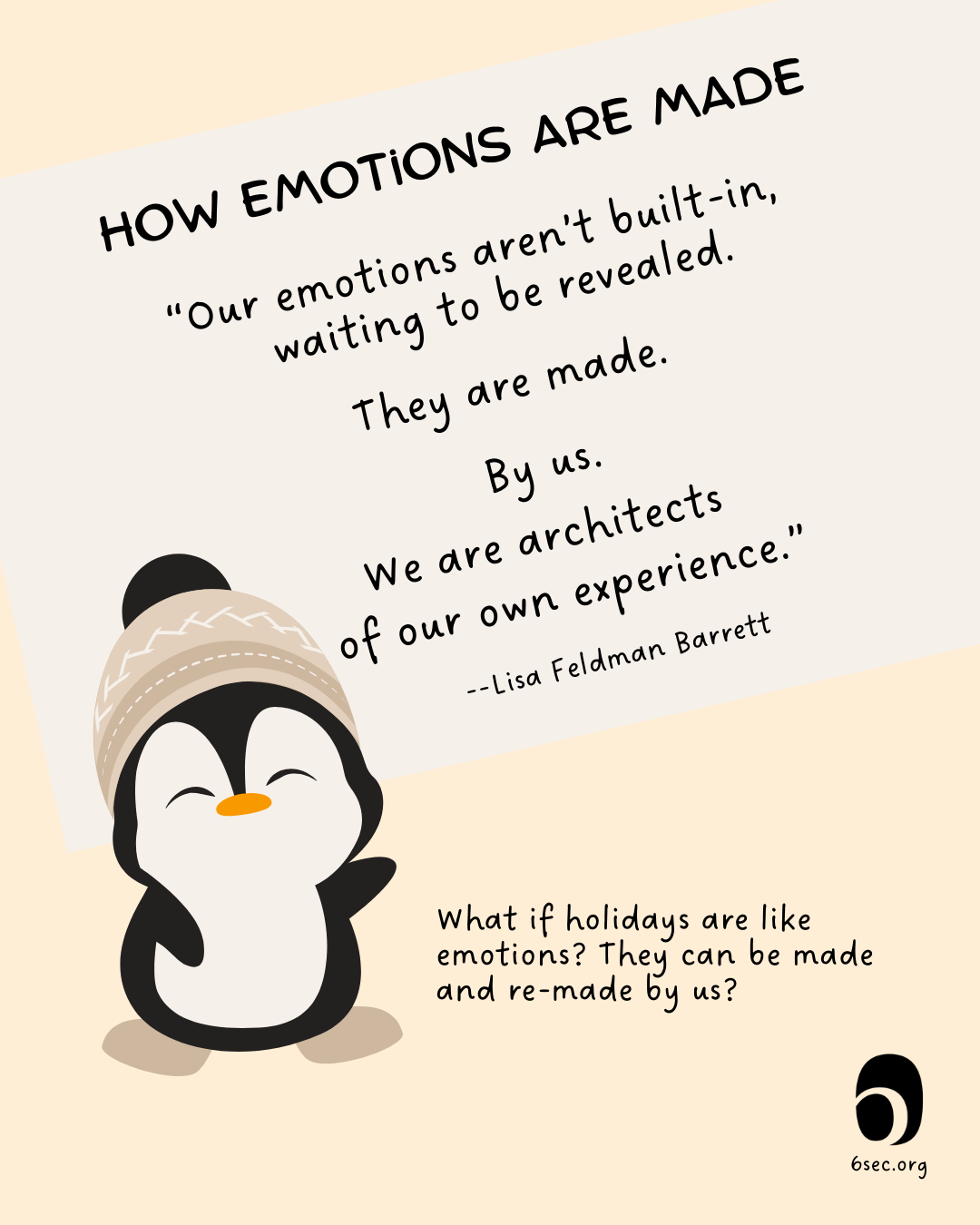
But like emotions, holidays aren’t hardwired. They’re assembled. Lisa Feldman Barrett writes in How Emotions Are Made:
“Our emotions aren’t built-in, waiting to be revealed.
They are made.
By us.
We are architects of our own experience.”
She explains that what we feel comes from the concepts we’ve learned, the roles we’ve played, and the patterns we’ve lived — the associations our brains built long before we knew how to question them. I think the same is true for the holidays. They come from the emotional cues we learned growing up, our roles, expectations, and associations still live in us. And just like with emotions, that means we can revise them. We can decide which parts still fit, and which parts we’re ready to release. We get to build something new.
‘Tis the Season for Self-Care
Whatever your triggers are, it’s important to take care of yourself and to know that it’s okay not to feel okay. Holidays put real pressure on our emotional systems. They are often a mix of joy and strain, and feeling stretched or overloaded is a very common experience.
It helps to lower the pressure, call on your supports (walks, breathing, calling a friend), and remember you don’t have to carry everything. This year I wanted to share a small toolkit, something simple, to help you work with whatever this holiday brings. Here are four that make the season feel brighter for me.
An Emotional Intelligence Toolkit for a Better Holiday
1. Traditions That Light You Up
Since the holidays are just a bag full of memories we pull out each year, let’s Marie Kondo them. What brings you joy? What can you let go of? What about adding something new? Be intentional about what you keep. If a tradition isn’t serving you any longer, let it go or change it. “We’ve always done it this way” doesn’t mean you can’t try something different. Choose one small practice that feels like you and let it become part of your season. Have fun and bring more light for yourself into the season.
2. Boundaries Are a Gift to Yourself
Some holiday stress comes from slipping into old roles or reacting out of habit. Before a gathering, pause and notice your typical Thought–Feeling–Action pattern. What usually gets triggered? How do you want to respond this time? A small boundary like a time limit, a topic you won’t engage in, a plan for stepping out to breathe, can protect your emotional energy and help you stay grounded. <Give yourself or your loved ones TFA cards on sale for the holidays!>
3. Unwrap Empathy — For Others and Yourself
Empathy helps you understand what someone else might truly want or need, which makes giving (gifts, attention, patience) more meaningful. But empathy also includes turning that care inward. Ask yourself: What would help me feel more supported this season? Self-empathy makes space for your limits, your feelings, and your needs so you’re not running on empty while trying to show up for everyone else.
4. Fill Your Stocking with Real Gratitude
Gratitude isn’t about pretending everything is blissful. It’s about pausing long enough to notice what’s good, or who is good, right in front of you. Let yourself feel appreciation fully. Notice the flavors of your food, the way the candlelight shines, the emotions of the moment, the effort someone made wrapping a gift. Real gratitude softens edges, shifts the emotional climate, and has a way of spilling over onto everyone around you.
What Will You Make of This Season?
“May your walls know joy, may every room hold laughter, and every window open to great possibility.” — Mary Anne Radmacher
I like that image — not because every holiday is joyful, but because possibility is always there, even in complicated and uncertain years.
So much of this season is inherited. But we get to shape it. We get to choose what we carry forward or release, and how we care for ourselves when old patterns show up. Emotional intelligence helps us stay grounded enough to do that. This year I want to notice what’s happening in myself, respond with intention, and build meaning that fits the life I’m living today.
However your holidays look this year, I hope you find moments of warmth that feel real, and traditions that feel chosen. And I hope you give yourself the same tenderness you offer everyone else.
For more articles, I recommend:

- Turn Up Your Sparkle: How Authenticity Can Be Your Greatest Asset - March 29, 2026
- Should I Stay or Should I Go? Understanding Your Emotional Needs - March 1, 2026
- Is Your Motivation Hiding? Shine a Light on It - February 3, 2026