

The Workplace
Vitality Study
Tracking the role of emotional intelligence in building workplace vitality since 2007
What are the key challenges people face at work?
How are organizations building the capacity to address these challenges?
What separates the top performing teams, leaders and organizations from everyone else?
These are some of the driving questions behind the Workplace Vitality Report, a global research project based on Six Seconds’ Vital Signs model and assessments that began in 2007. The current database includes over 50,000 people from different nationalities, business sectors and company sizes. The goal is to understand the factors driving organizational performance today, especially for leaders and teams. The 2022 report focuses on teams and how the COVID-19 pandemic affected team performance. Researchers used the Team Vital Signs assessment, a normed and validated psychometric tool that measures team climate, engagement and performance.
2022 Workplace Vitality Report
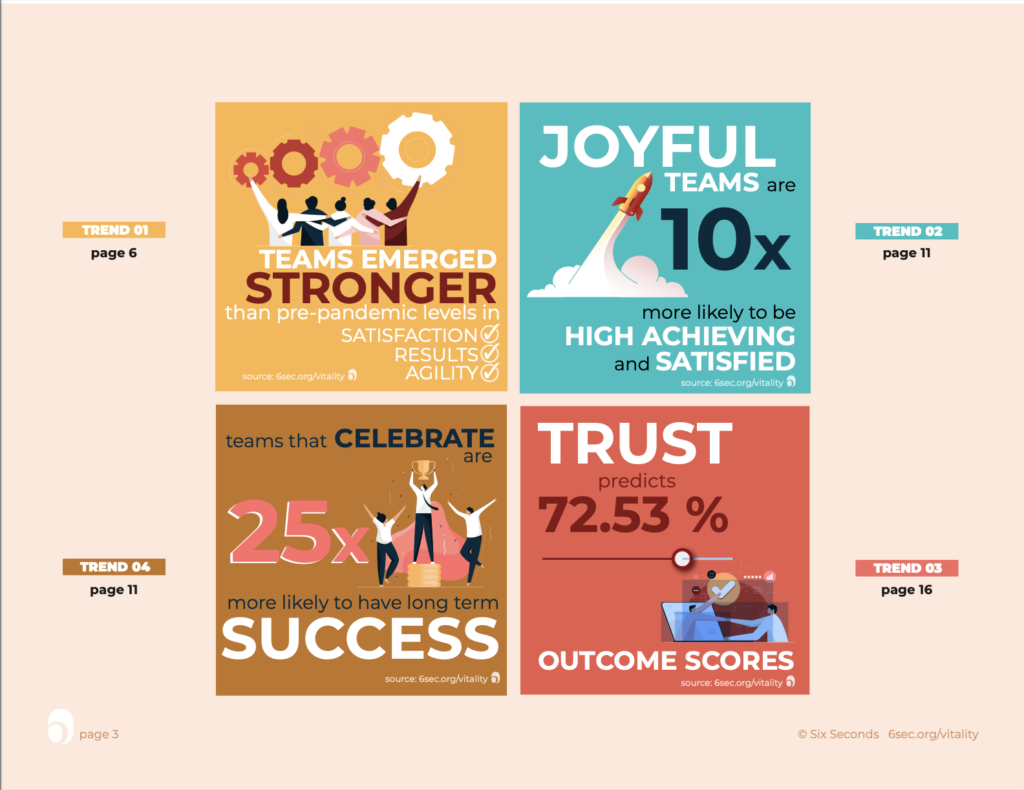
The 2022 edition of the Workplace Vitality Report is here – focused on team performance at work and the impact of the COVID-19 pandemic. These 4 key findings can help you optimize team performance with emotional intelligence.
What you’ll get:
✓ New global research on the impact of the COVID-19 pandemic on work teams and what fueled the top performing teams
✓ Expert analysis from the world’s largest organization dedicated to emotional intelligence
✓ Practical tips and strategies to enhance climate, increase engagement, and boost performance with your team
Download the full report now: http://6sec.org/vitality22
2020 Workplace Vitality Report
The 2020 edition of the report is here, focused on individual leadership. Key findings:
66% of the variation in leadership outcomes is predicted by 5 key drivers of “vital leadership.”
Leaders who score high on emotional intelligence are 7x as likely to have high leadership performance outcomes.
The emotional intelligence competency of Exercise Optimism has the highest impact on leadership vitality, predicting 31% of the variation in scores on a leaders’ capacity to drive change.
Leadership capabilities are key to personal outcomes, in particular the leadership vitality driver of Trust predicts 34% of the variation in personal outcome scores (wellbeing, effectiveness, quality of life, relationships).
2017 Workplace Vitality Report
This report is available by filling in the form below
When trust in the workplace is high, it is 27x as likely to be high performing.
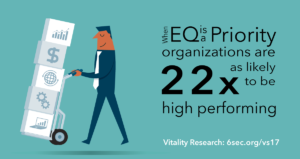
When emotional intelligence is a priority, organizations are 22x as likely to be high performing.
Top issues at work:
1. People Leadership
Poor leadership/management creating lack of communication, little change, and low trust.
2. Great Resources
People don’t have the time, or enough employees on the team, to do the work.
3. Compelling Vision
Short term focus = lack of planning. The vision / direction / goals are not clear.
2012 Workplace Issues Report
The top words used to describe challenges: Retention, Talent, Leadership.
How effective are leaders in your organization at driving change? Score: 61.7 / 100 (D)
To what degree is the development of future leaders a priority in your organization? Score: 70.9 / 100 (C-)
To what degree are emotional intelligence skills (e.g., recognizing & managing feelings, building trust, making careful decisions) important in addressing the top issues? 4.5 out of 5
To what degree is emotional intelligence training & development a priority in your organization? 2.6 out of 5
That’s a 74% gap between the perceived value and implementation
2010 Workplace Issues Report
The most pressing challenge today is maintaining a healthy culture under intense economic pressure.
Getting and keeping good people – especially “people people” – will make the difference.
Only 8% of respondents report that they’re fully trained to deal with the issues they’re seeing.
92% see the value of EQ — but only 33% say their organizations do likewise.
2007 Workplace Issues Report
76% of the issues managers identify as “top challenges” are on the people-side (vs financial & technical).
“Soft” issues such as finding and keeping talent are over 3 times as prevalent as “hard” issues such as finance.
Leaders are twice as concerned about leadership than all other issues combined.
Top issues are around leadership, change management, and fostering a healthy environment where people can sustain productivity.
While many respondents see emotional intelligence as valuable, for most it’s unclear how to access that value.
.
What’s new in emotional intelligence?

Gen Z Is Unlike Any Generation Before It. New Research Reveals Why – and How to Work More Effectively with the iGen
Here are 3 key insights from the world’s largest study of emotional intelligence, and what it means for working effectively with Zoomers.

Knowing Isn’t Coaching: Three Emotional Intelligence Tools for Professional Coaches
Here’s how to use emotional intelligence to break out of a fixed mindset of “knowing the answer” and make your own (difficult) emotions an ally as a coach.
Voices from the Network: Huong Nguyen
This month we sit down with Ms. Huong Nguyen, a medical doctor and certified EQ Coach, EQ Facilitator, Practitioner and Assessor who has been working to expand her local EQ community in Vietnam.

Coaching Down the Escalator: 3 Emotional Intelligence Tips for Coaches to Reduce Volatility & De-escalate Conflict in a Polarized World
As people become more volatile around us, our brains’ natural response is to also become more reactive. Coaching provides a perfect opportunity to step out of this cycle of escalation, but it’s a difficult emotional puzzle; here’s a map of the process with three emotional intelligence tips for coaches.
Dr. Daniel Goleman Explains the History of Emotional Intelligence
Daniel Goleman explains the history of emotional intelligence – and why EQ is important in business, education & life.
Voices form the Network: Jacqui Butler & Svetlana Suvorova
When Jacqui Butler and Svetlana Suvorova met in Six Seconds’ EQ Coach Certification program in 2022, they clicked right away. After building a strong connection of mutual support and collaboration, they recently launched a joint venture, LeadEQ, to support women leaders. This is their story of finding EQ, each other, and a deeply meaningful path of professional growth.

Account Login
login, change password

Tools System
manage assessments

EQ.org
cert eLearning & library

Knowledge Base
get how-to info

Help Desk
get tech support

Contact Us
we’re here to help

EQ Store
buy resources

TFA Online
TFA cards app

Event Calendar
quickly find all classes

- Knowing Isn’t Coaching: Three Emotional Intelligence Tools for Professional Coaches - April 3, 2024
- Coaching Down the Escalator: 3 Emotional Intelligence Tips forCoaches to Reduce Volatility & De-escalate Conflict in a Polarized World - March 6, 2024
- Dr. Daniel Goleman Explains the History of Emotional Intelligence - February 29, 2024
Hello there! Can you please share the full report!
Thanks for checking: This is the full report! And we have a PDF version coming soon