

Plutchik’s Wheel of Emotions: Exploring the Feelings Wheel and How to Use It (+ PDF)
Emotions can be complex, scary and overwhelming. How can we make sense of them, navigate them more effectively, and not feel overwhelmed by them? Plutchik’s Wheel of Emotions, or Feelings Wheel, is a valuable resource to make sense of feelings and grow your emotional literacy, one of the foundations of practicing emotional intelligence.
Read on for an in-depth analysis of Plutchik’s Wheel of Emotions and to get your free eBook, Practicing Emotional Intelligence, which includes Plutchik’s Wheel of Emotions, the new Feelings Wheel and other hands-on activities to improve your emotional intelligence. Let’s dive in to Plutchik’s Wheel of Emotions!
What you’ll find on this page
➔ What Is Plutchik’s Wheel of Emotions?
➔ Free Emotional Intelligence eBook with Plutchik Exercises
➔ How to Use the Feelings Wheel
➔ Explore interactive version of Plutchik’s Wheel of Emotions
➔ Plutchik’s Wheel and the Six Seconds Model of Emotional Intelligence
➔ How Is Plutchik’s Wheel of Emotions Different from the Feelings Wheel?
➔ How to Teach Emotional Literacy to Children
What Is Plutchik’s Wheel of Emotions?
Created by American psychologist Robert Plutchik in 1980, Plutchik’s Wheel of Emotions is a graphic depiction to describe how emotions are related. Through years of studying emotions, Dr. Plutchik proposed that there are eight primary emotions that serve as the foundation for all others: joy, sadness, acceptance, disgust, fear, anger, surprise, and anticipation.
These eight primary emotions are grouped into polar opposites, based on the physiological reaction each emotion creates in animals:
- Joy is the opposite of Sadness.
Physiology: Connect vs withdraw - Fear is the opposite of Anger.
Physiology: Get small and hide vs get big and loud - Anticipation is the opposite of Surprise.
Physiology: Examine closely vs jump back - Disgust is the opposite of Trust.
Physiology: Reject vs embrace
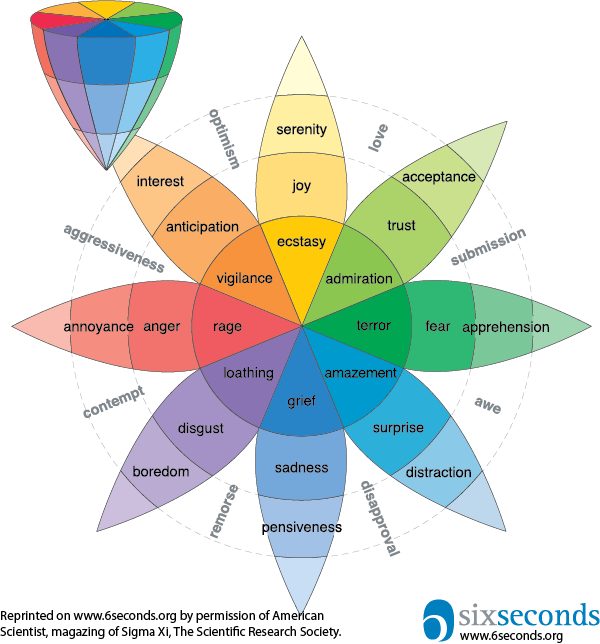
Explore the Interactive Wheel of Emotions
Plutchik’s Emotion Wheel is great starting point for improving your ability to identify your emotions and practice emotional intelligence. Use this interactive Wheel to get started today!
Want to learn more about emotions and emotional intelligence? Get your free 44-page eBook to explore Plutchik’s Wheel of Emotions and how you can use it to start practicing emotional intelligence.

Elements of the Wheel
Here are the main elements of the Emotion Wheel to be aware of:
Primary: The eight sectors are designed to indicate that there are eight primary emotions: anger, anticipation, joy, trust, fear, surprise, sadness and disgust. Primary emotions are located in the second circle.
Opposites: Each primary emotion has a polar opposite. See above.
Intensity: The cone’s vertical dimension represents intensity – emotions intensify as they move from the outside to the center of the wheel, which is also indicated by the color: The darker the shade, the more intense the emotion. For example, anger at its least level of intensity is annoyance. At its highest level of intensity, anger becomes rage. Or, a feeling of boredom can intensify to loathing if left unchecked, which is dark purple. This is an important rule about emotions to be aware of in relationships: If left unchecked, emotions can intensify. Herein lies the wisdom of enhancing your emotional vocabulary: it’s the bedrock of effectively navigating emotions.
Plutchik’s Wheel of Emotions helps us look at literacy through a broader lens. Literacy means “a person’s knowledge of a particular subject or field.” So enhancing emotional literacy means not only having words for emotions, but understanding how different emotions are related to one another and how they tend to change over time.
Combinations: The emotions with no color represent an emotion that is a mix of the 2 primary emotions. For example, anticipation and joy combine to be optimism. Joy and trust combine to be love. Emotions are often complex, and being able to recognize when a feeling is actually a combination of two or more distinct feelings is a helpful skill.
You can read Robert Plutchik’s explanation of his model of emotions in an article that was originally published in American Scientist in 2001 and can be read on Springer International Publishing AG.
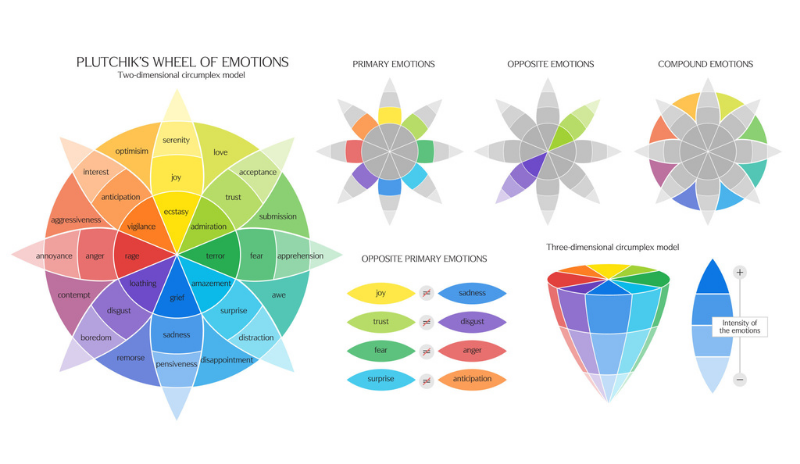
The Feelings Wheel and How to Use It
The ability to identify one’s emotions is a foundational emotional intelligence skill. (Salovey & Mayer, 1990). People with strong emotional literacy can describe emotional experiences in greater detail, and research has linked this with greater emotion regulation (Kircanski et al., 2012). Naming, or labeling your feelings is a powerful practice to regulate and navigate emotions.
Plutchik’s Emotion Wheel is great starting point for improving your ability to identify your emotions and practice emotional intelligence.
So let’s put it into action:
- Start by taking a breath and noticing the emotions you are feeling.
- Ask yourself the question, “What am I feeling right now? And what else?”
- Take a look at the wheel and choose the corresponding emotion/emotions from the wheel. (It’s normal to have layers of feelings, some quiet and some loud and/or a combination).
- Notice the intensity of the emotion & consider what these emotions are trying to tell you. Remember that you can experience a number of different emotions simultaneously, and that the wheel should not be used for avoiding emotions or replacing ‘negative’ emotions with ‘positive’ ones. All emotions have value and an important message.
- Ask yourself, what do these feelings want me to notice or do?
- Use the interactive version of Plutchik’s Wheel of Emotions below to understand your emotions more deeply. Learn the messages they are trying to convey and what physical sensations these emotions can cause.Want to explore Plutchik’s Wheel more deeply and get practical activities to apply emotional intelligence in your work and life? Download our free Practicing EQ eBook.
Plutchik’s Wheel of Emotions and the Six Seconds Model of Emotional Intelligence
Plutchik studied animals, and he proposed a psychoevolutionary classification approach for general emotional responses. A core belief of Plutchik’s is that all emotions serve a functional, evolutionary purpose, and therefore have value. There are no ‘good’ or ‘bad’ emotions. Each emotion serves a purpose that supports humans to survive and thrive. Fear, for example, helps us focus on what we want to protect and move back to avert threats. Anger helps us to notice what is in the way, energizes us to break through obstacles. download our free Practicing EQ eBook to learn the utility of the 8 basic emotions.
At Six Seconds, our work is grounded in this adaptive theory of emotions. The Six Seconds Model of Emotional Intelligence is a 3-step process for practicing emotional intelligence, which starts with recognizing and labeling emotions.
“We use the Plutchik model in most of our workshops and trainings,” says Six Seconds CEO Joshua Freedman. “It’s both beautiful and practical, simple and complex. These two models complement each other well, since Plutchik’s Wheel focuses on naming and understanding emotions and the Six Seconds Model on how to use that information to take appropriate action.”
Learn more about the Six Seconds Model →
Before you read on, we thought you might like to download our free Practicing EQ eBook. These evidence-based exercises will not only enhance your ability to understand and work with your emotions, but will also give you the tools to foster the emotional intelligence of your clients, students or employees.
Download the Free Practicing EQ eBook
Want to learn more about emotions and emotional intelligence? Get your free 44-page eBook to explore Plutchik’s Wheel of Emotions and how you can use it to start practicing emotional intelligence.
What’s included:
- Free Plutchik Wheel of Emotions poster for your office or classroom
- Dozens of activities and exercises to practice emotional intelligence
- Dozens of words for feelings to grow your emotional literacy
- 8 emotion principles to live by

How Is Plutchik’s Wheel of Emotions Different Than the Feelings Wheel?
The Feelings Wheel is a visual representation of different emotions created by Gloria Willcox. The wheel defines only six basic emotions: anger, fear, sadness, calm, strong, and happiness, and each of these emotions is then divided into more specific sub-emotions. There are 72 feelings total. As you move toward the outer edges of the wheel you’ll find more specific emotions.
While not as complex and multidimensional as Plutchik’s Wheel of Emotions, the Feelings Wheel is a useful tool for considering emotions and practicing emotional intelligence.

How to Teach Emotional Literacy to Children
There are several tools that can help children understand their emotions. With the release of Pixar’s animated movie, Inside Out, there are many materials available to start such conversations with younger kids. Please check out this free eBook, Practicing Emotional Intelligence with Inside Out 2.
Save your seat today for one of our upcoming global livestreams:

Emotion Rules
Joshua Freedman's new book on the science and practice of emotional wisdom — 12 rules that decode the architecture of feelings.
Get the Book — $19.95
Full Practicing EQ eBook
44 pages, 8 core facts about emotions and EQ, plus 10 practical worksheets to use with yourself or your clients.
Get the eBook — $38.95
Evoke Metaphor Cards
An engaging way to express feelings, set goals, and expand your thinking — 36 metaphor cards plus 7 instruction cards.
Shop Now — $28.95What’s new in emotional intelligence?

Mixed Emotions: There’s Meaning in the Mix – The Neuroscience of Understanding Emotion
We rarely feel one clean emotion at a time — and that’s a feature, not a bug. A look at why mixed emotions are a human asset, and how naming them helps you make sense of what matters… so you can stop looking at the surface and see the full iceberg.

Women in Leadership: The Emotional Intelligence Skills That Drive Workplace Wellbeing
What a study of 43,080 women across 114 countries tells us about thriving, and what organizations can do about it

Emotional Intelligence at Work: 10 Lessons from 50 Case Studies
What FedEx, Sheraton, Komatsu, and 47 other organizations reveal about emotional intelligence at work — 10 patterns HR leaders can put to use immediately.

Emotional Intelligence for Positive Mental Health: From Surviving to Flourishing
Learn how emotional intelligence and self-compassion can help you move toward thriving, with 50+ research-based practices for flourishing. What if mental health isn’t just the absence of illness — but a continuum from surviving to full vitality?

Turn Up Your Sparkle: How Authenticity Can Be Your Greatest Asset
Your authenticity, your sparkle, is not just who you are at your best — it’s also one of your greatest assets. Here’s how to use emotional intelligence to make your authentic sparkle shine.

Should I Stay or Should I Go? Understanding Your Emotional Needs
When you’re facing an internal conflict, emotions can become confusing. Here’s how to “look beneath the surface” to discover the needs hiding behind your feelings.

- Leading Kindness: When College Students Practice EQ in Service of Others, Their Own Emotional Intelligence Increases - April 9, 2026
- Emotional Intelligence in Healthcare: A Quick Check-In Guide to Improve Patient Care and Reduce Burnout - November 18, 2025
- Plutchik’s Wheel of Emotions: Feelings Wheel - February 6, 2025