

3 Tips to Fuel Motivation from the Inside Out: The Motivation Iceberg
The Motivation Iceberg is a simple, clear model that shows how different motivators drive different kinds of performance. It helps managers, leaders, parents, educators – anyone concerned with motivating others – consider how to use their emotional intelligence to fuel lasting motivation… and it’s especially important when people are working remotely or in times of change and challenge.
Keep reading to learn more about the ins and outs of motivation and get a FREE worksheet on choosing the right motivators to get the results you want.

What Drives Star Performance?
One of the central challenges of managing and leading is to inspire and engage — to motivate — people to optimal performance.
People are paid to do their work, and eventually they should lose their jobs if they don’t meet expectations. But in most roles, in most organizations, star performance requires a higher level of engagement — a commitment that goes beyond the paycheck. This is especially visible in remote-work situations when “no one is ‘standing over your shoulder.’ Why work?” That extra commitment is called “discretionary effort” because it’s at the employee’s discretion. They give that extra because they want to — because they feel like it. True leaders are able to inspire that feeling. As FedEx founder Fred Smith said, “Leadership is getting people to work for you when they are not obligated.”
As we consider “motivating employees,” we can divide the work we want to achieve in two basic categories of outcomes:
1: Basic, task-oriented, behavioral work
Showing up on time. Filing required reports. Making the required number of calls. These tend to be prescribed, tactical, and easily measurable.
2: Knowledge & creative work
This category is more about the quality of the employee’s work. We want them to care for customers. To innovate new solutions. To give their all. To trust and be trustworthy. To show up and do their best in the middle of a pandemic… to do their best even when no one is watching.
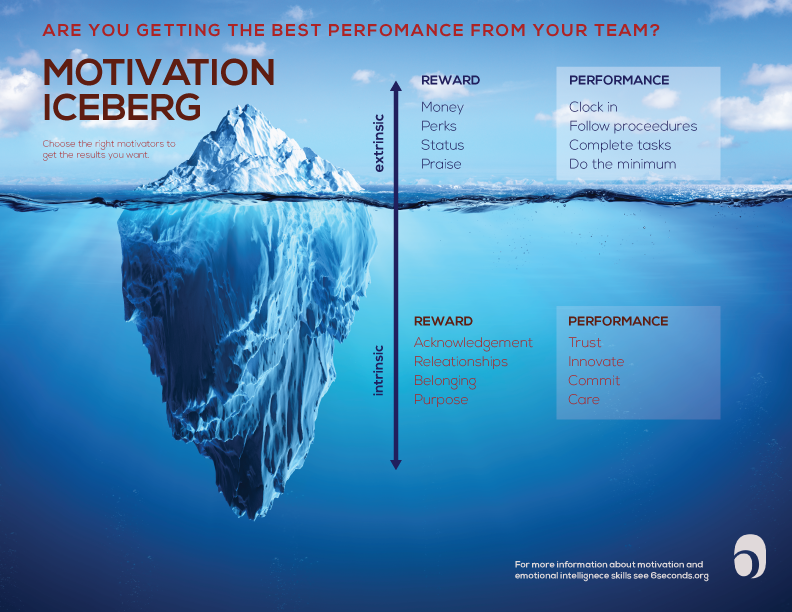
Get your Motivation Iceberg poster
How can you inspire a level of engagement that goes beyond the paycheck? It starts with understanding how you’re trying to motivate, because different motivators drive different levels of engagement.
Basic work can be done without any particular human spark (and is easily automated); people do it because they need a paycheck. But when we want to influence knowledge/creative work, it’s not just a “behavior” we need, but a quality… heart… passion… something unique… the typical, transactional carrots and sticks actually undermine this kind of motivation.
Managers who rely on the old-school, transactional methods will fail to get full value from people – and in difficult situations, such as remote work, performance will plummet.
Different people, and different situations, require more nuanced and intentional understandings of motivation. Fortunately, these are MEASURABLE, and so even in a context like remote work during a pandemic, managers can learn to engage their own and their people’s deeper drivers.
What Actually Drives Behavior?
An iceberg is a useful metaphor for these two categories. At the tip of the iceberg are those visible, tangible activities; the first category. Beneath the surface are the invisible, emotional drivers which shape attitude; the second category. These emotional drivers make the difference in how activities are done and thereby define the impact employees have on customers and colleagues. Above the surface is what’s visible. Below is what’s invisible. Above is BEHAVIOR, below is what DRIVES behavior.
So what kinds of motivators work best for these two parts of the iceberg?
Most organizations fail to get full value from their people because they build ‘motivators’ that are easy, rather than smart.
Extrinsic vs. Intrinsic Motivators
In addition to different categories of outcomes, there are different kinds of motivators; different “levers” that managers can use to engage performance. There are two basic categories for these levers – “extrinsic” and “intrinsic” – and they tend to be most effective for one type of outcome or the other. Here are examples of each:
Extrinsic Motivators
Live outside the employee (e.g., bonuses, perks, fines, employee of the month).
Delivered by the CEO, the manager, or the organization.
Easy to quantify, concrete.
Require ongoing expense (e.g., more bonus funds).
Reinforce power structure (higher ups decide and dole out).
Intrinsic Motivators
Live inside the employee (e.g., passion, alignment with values, belonging, purpose).
Driven by relationships and organizational climate.
Intangible, abstract.
No ongoing expense and spread from employee to employee.
Reinforce interdependence (shared responsibility).
While we can categorize two kinds of motivators, it’s more accurate to consider a spectrum. For example, while salary is extrinsic, many employees are using their salary to support their families, which can be intrinsic.
Not surprisingly, different kinds of motivators drive different kinds of performance. But one of the most dangerous and common pitfalls in organizations is the use of one type of motivator for all employees and all goals.
Take, for instance, a typical incentive program. Salespeople get a bonus for meeting a certain quota, set by the management. In this case, the salesperson is rewarded for making the sale irrespective of how it’s done. Many salespeople like it and it’s easy for sales managers to incentivize ‘tip of the iceberg’ behavior. However, the operations people are rarely thrilled with the way salespeople over-promise to customers; they are the ones who have to respond to the nasty customer reviews. Furthermore, the top salespeople routinely leave to find better-paying opportunities, so the turnover cost is high. And consider this: What happens when the business model changes, and the salespeople find themselves needing to collaborate?
Or, what happens when suddenly the workplace changes and employees are working from home (WFH)? The reliance on transactional management means employees were “forced to care” because they’d be caught out… and so now they can sit in Zoom meetings playing on their phones and the transactional managers have no leverage.
…different kinds of motivators drive different kinds of performance. But one of the most dangerous and common pitfalls in organizations is the use of one type of motivator for all employees and all goals.
Different Motivators for Different Results
We’re starting to see some of the complexities of motivation, and how different factors motivate people in different situations. One of the keys to this puzzle is to match different types of motivators with different types of needs.
Download the graphic to the right for an up close look at what motivators drive what types of outcomes.
As you can see, the extrinsic (“above the surface”) motivators drive “above the surface” outcomes. And the intrinsic (“below the waterline”) motivators that drive “below the surface” outcomes.
What’s critical to remember is that extrinsic levers (top left) do not effectively motivate the deeper outcomes (bottom right). In fact, emphasizing these extrinsic influences can undermine this kind of ‘beneath the surface’ commitment.
For example, if you want your employees to be more trustworthy, it probably isn’t a good idea to set up a financial reward system for employees who tell the truth the most. You may be better off thinking about how you can create a sense of belonging for your employees, like informal gatherings or listening more.
This is particularly difficult in remote work where isolation will creep in. It’s why good managers prioritize collaboration, group projects, and relationship-building. Not as an add-on, but as a central part of what makes great work.
This is not to say the extrinsic motivators are irrelevant, but rather to say we need to use the correct motivator for the desired outcome.
The big challenge is that because it is incredibly easy to offer an extrinsic carrot, that method becomes the default. Extrinsic factors are measurable, concrete, and reinforce the power structure in the organization – which makes these quite attractive to organizational systems. Quite satisfying except for one key obstacle: when it comes to engaging hearts and minds, they don’t work.
Extrinsic factors are measurable, concrete, and reinforce the power structure in the organization – which makes these quite attractive to organizational systems… but they don’t actually motivate people.
Three Tips for Engaging Intrinsic Motivation
While it’s more work to develop intrinsic motivators, if you want to engage those “beneath the waterline” outcomes, this work is not optional. Here are three tips:

Develop Powerful Values
Most organizations have a list of values but are they real or are they PR? Do people really live by them?
Recently I was with a group of director-level managers in a huge multinational and when I asked about the corporate values they all groaned and mocked the mission statement: They perceived that the values were just window dressing and the real driver was profit. While they liked making money, they had no real loyalty to the organization.
Yet in the same organization, when I talk to senior VPs they have a sense that the organization stands for something significant and is based on over 100 years of adherence to important, enduring values. Somehow the talk about “driving results” has completely eclipsed those values. The result is a whole level of critically important leaders who are fundamentally disconnected from the organization.
Does this gap exist in your company? Does your organization have values that have real meaning to your people? Are you talking about them, living them, noticing them in others, and taking corrective action when people violate them?

Connect With People
One of, if not THE, most fundamental intrinsic motivator is belonging. Humans are pack animals, wired to connect.
Humans are pack animals, and as such we are wired to connect. Yet most senior leaders have a schedules double- and triple-booked out months ahead with nearly no opportunity to interact on a human level.
When was the last time you were “just hanging out” at lunch team members two or three levels below you? When was the last truly honest conversation you had with a colleague where you genuinely listened to her story? How much time are you spending connecting with people outside your team and business unit versus inside? This is not rocket science, but it is just as powerful.

FEEL Purpose
Why does your organization exist? It makes money in order to exist, but what does it exist for?
If you don’t have a compelling, powerful answer to that question you will not build enduring intrinsic motivation, and the best people will not stay with you – so get a great consultant coach and develop an answer.
If you do have that answer, an answer that is worth fighting for, then tell that story over and over. Everything you do should serve that purpose, and if it doesn’t, change what you do. Every change you make, every message you roll out, should be linked to that purpose. Junior employees will rarely say it out loud, but just know they’re constantly asking, “Why should I give you my all?” Make sure you’ve got a worthwhile answer, and then make sure they hear it.
While this work is challenging, it has long-lasting benefits. When you get these core drivers in place, they become part of the organizational culture. Intrinsic motivation lasts. But who has time?
Discussing this type of work with leaders, many of my clients’ first reaction is: “This sounds right, but I just don’t have time.” If you’re like most managers, you have too much to do just getting the basic tasks done. It’s like you’re on a treadmill chasing to catch up. So here’s a hard truth: Unless you do the leadership work of building intrinsic motivation, your treadmill is just going to go faster and faster.
There is no “right time” to stop chasing and start leading. No one is going to gift you with blocks of uninterrupted time to shift your attention to the “heart of the iceberg.” You have to decide that it is important, and carve the time out for yourself. That’s where the real opportunity lives.
Notes:
For further reading on this topic, check out 5 tips: Using EQ to Build a High Performing Culture
For even more, learn to measure these drivers with the EQPlus Driving Forces assessment
This article was updated from a previous version. The “Motivation Iceberg” model is explored in “Motivation from the Inside Out,” a workshop in Six Seconds’ Developing Human Performance curriculum. DHP provides 14 essential building blocks for organizational performance in practical, engaging 2-hour workshops that can be used by almost any competent development professional.
What’s new in emotional intelligence?

Emotional Intelligence at Work: 10 Lessons from 50 Case Studies
What FedEx, Sheraton, Komatsu, and 47 other organizations reveal about emotional intelligence at work — 10 patterns HR leaders can put to use immediately.

Leading Change in Times of Uncertainty: Why Managing Transitions Matters More Than Strategy
Leading change in times of uncertainty requires more than strategy. Learn why emotional transitions, trust, and purpose drive sustainable change.

Emotion AI: A Leader’s Guide to Use Emotional Intelligence for Effective AI Adoption and Change Management
AI adoption challenges are emotional before they’re technical. Learn how fear, curiosity, and emotional intelligence shape whether AI succeeds in your workplace.

Requesting Trust: 5 Practical Steps to Repair and Increase Trust
Want to increase trust with someone? Try this challenging-but-rewarding framework for requesting trust.

Emotional Intelligence in Healthcare: A Quick Check-In Guide to Improve Patient Care and Reduce Burnout
Discover how emotional intelligence can help healthcare professionals reduce burnout, strengthen teamwork, and improve patient care.

Leading Your Team Through Change
When facing challenges leading team change, increasing trust, vitality and purpose are key factors to success.

- Emotional Intelligence at Work: 10 Lessons from 50 Case Studies - May 26, 2026
- Emotional Intelligence for Positive Mental Health: From Surviving to Flourishing - April 26, 2026
- Emotions Travel in Packs: What Your Feelings Are Really Trying to Tell You (The Emotion Constellation Map) - March 23, 2026