

Make people your competitive advantage
Embed emotional intelligence at every level to fuel engagement, retention and performance.

Emotions drive people. People drive performance.
The Challenge
Today, keeping your best people is hard—and sustaining high performance is harder. Leaders are expected to hit targets and deliver results amid burnout, disengagement, resource constraints, and increasing complexity.
Six Seconds research shows that organizations prioritizing emotional intelligence are 22x more likely to be high performing — because they unlock their people’s full potential. In a fast-paced, global economy, investing in your people and culture is no longer optional.
The Outcomes We Deliver
When you partner with Six Seconds, you can expect:
1. More effective leadership
Develop leaders who inspire, connect and deliver results
Equip leaders at every level with the emotional intelligence skills to foster trust, drive collaboration, and lead through complexity.
Key Outcomes:
- Smarter, faster decision-making under pressure.
- Better teamwork through stronger trust and communication.
- Customer loyalty driven by authentic, people-focused leadership.
Learn More →
Case study: Learn how Kuehne + Nagel reshaped daily leadership choices, reduced conflict, and increased operational effectiveness →
3. Better retention and talent management
Attract, grow and keep the right people
Build a talent system that selects for fit, accelerates development, and turns managers into coaches who grow capability.
Key Outcomes:
- Better hiring and role fit through behavioral insight and EQ-informed selection.
- Faster ramp and internal mobility with clear feedback and coaching pathways.
- Lower regrettable attrition by aligning strengths, career paths, and expectations.
Learn More →
Case study: Learn how the FedEx Global Leadership Institute developed its next generation of leaders →
5. Quality customer experiences
Earn loyalty with emotionally intelligent customer journeys
Deliver consistent, empathetic experiences across marketing, sales, and service so customers trust—and return.
Key Outcomes:
- Higher CSAT/NPS and repeat purchase through clear, human-centered interactions.
- Stronger recovery when things go wrong; fewer escalations and churn risks.
- Consistent delivery across channels and teams, aligned to customer needs.
Learn More →
Case study: Learn how UCB improved internal exchanges and strengthened key relationships →
2. Stronger engagement, teamwork and culture
Create a culture that inspires connection, commitment, and growth
Design a high-trust environment where people bring energy to the work and teams execute consistently.
Key Outcomes:
- Higher engagement and discretionary effort across teams and functions.
- Trust that reduces friction and silos, improving collaboration and speed.
- Reduced burnout and a healthier work climate that sustains performance.
Learn More →
Case study: Learn how Siemens doubled the number of highly engaged managers →
4. Effective AI adoption and change management
Lead change people believe in—and sustain
Equip leaders and teams to navigate transformation with clarity, empathy, and ownership. In the era of artificial intelligence, change management is a core business function.
Key Outcomes:
- Faster adoption and execution of strategic initiatives.
- Less resistance and more accountability through clear, two-way communication.
- Greater resilience and lower change fatigue during ongoing transformation.
Learn More →
Case study: Learn how the UK’s National Health Service navigated COVID complexity and burnout in healthcare →
6. Increased Sales and Revenue Impact
Connect, discover, and close with EQ
Enable sales teams to build trust, understand needs, and advance opportunities with confidence.
Key Outcomes:
- Higher win rates through deeper discovery and credibility.
Shorter sales cycles and improved forecast accuracy with clearer next steps. - Stronger cross-sell/upsell and retention from long-term relationship depth.
Learn More →
Case study: Learn how Sheraton increased guest satisfaction, revenue, and market share →
How We Do It
Launch quickly from a proven library of evidence-based tools and programs based on over 25 years experience – and then refine where it matters most. We customize content to your culture, priorities and KPIs. Our approach blends:

Interactive Training
Engage people with hands-on learning they’ll remember and use

Validated Assessments
Measure what matters, so you know where to focus and how to prove ROI
Tools include self-assessments, 360 assessments, and group reports.

Coaching & Consulting
Embed emotional intelligence into your culture to exceed your KPIs
Get Started Today
Launch quickly from a proven library of evidence-based tools and programs based on over 25 years experience – and then refine where it matters most. We customize content to your culture, priorities and KPIs. Our approach blends:
1. Tell us about your goals
We start by listening to your needs and goals. What’s the change you most want to see? How can we help you achieve that? We clarify business goals, define the KPIs that matter (retention, engagement, CX, sales), and walk you through a clear process for implementation.
Schedule a consultation to get started today.
2. Create a custom solution to meet your needs
We customize a unique solution for every client. There is no one-size-fits-all. We recommend a right-sized blend—interactive training, leadership coaching, and measurement—mapped to your goals, constraints and calendar.
Schedule a consultation to get started today.
3. Get reliable data on the current reality
We use psychometrically validated assessment tools to get actionable data and establish a baseline for our work together. Do you know what percentage of your workforce is engaged? How are the levels of trust? We measure the invisible drivers of results.
Schedule a consultation to get started today.
4. Build capacity for improving KPIs
Our interactive, evidence-based programs build emotional intelligence skills and are designed to boost engagement, retention, and performance — tailored to your people and your goals.
Schedule a consultation today to learn more.
5. Re-test to measure progress toward goals
We re-measure against the baseline and your KPIs, always committed to achieving your goals, and to sustain and scale what’s working.
Schedule a consultation today to learn more.
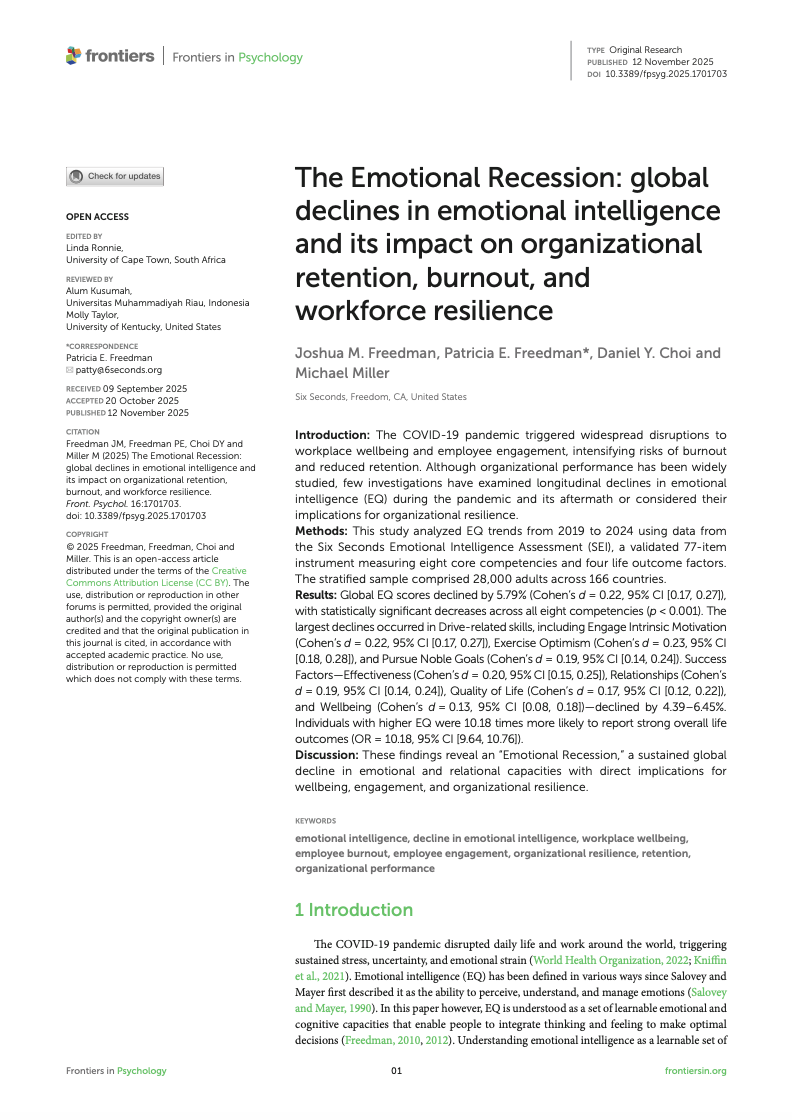
Download our published research on organizational retention, burnout, and workforce resilience
Get your free copy today and started solving your most pressing business challenges.
Areas of Expertise
Partner with us to solve your most pressing problems.
1. Leadership Development
Develop leaders who inspire, connect and deliver results
Equip leaders at every level with the emotional intelligence skills to foster trust, drive collaboration, and lead through complexity.
Key Outcomes:
- Smarter, faster decision-making under pressure.
- Better teamwork through stronger trust and communication.
- Customer loyalty driven by authentic, people-focused leadership.
Case study: Learn how Kuehne + Nagel reshaped daily leadership choices, reduced conflict, and increased operational effectiveness →
2. Talent Management
Attract, grow and keep the right people
Build a talent system that selects for fit, accelerates development, and turns managers into coaches who grow capability.
Key Outcomes:
- Better hiring and role fit through behavioral insight and EQ-informed selection.
- Faster ramp and internal mobility with clear feedback and coaching pathways.
- Lower regrettable attrition by aligning strengths, career paths, and expectations.
Case study: Learn how the FedEx Global Leadership Institute developed its next generation of leaders →
3. Engagement, Teamwork & Culture
Create a culture that inspires connection, commitment, and growth
Design a high-trust environment where people bring energy to the work and teams execute consistently.
Key Outcomes:
- Higher engagement and discretionary effort across teams and functions.
- Trust that reduces friction and silos, improving collaboration and speed.
- Reduced burnout and a healthier work climate that sustains performance.
Case study: Learn how Siemens doubled the number of highly engaged managers →
4. Effective AI Adoption and Change Management
Lead change people believe in—and sustain
Equip leaders and teams to navigate transformation with clarity, empathy, and ownership. In the era of artificial intelligence, change management is a core business function.
Key Outcomes:
- Faster adoption and execution of strategic initiatives.
- Less resistance and more accountability through clear, two-way communication.
- Greater resilience and lower change fatigue during ongoing transformation.
Case study: Learn how the UK’s National Health Service navigated COVID complexity and burnout in healthcare →
5. Customer Experience
Earn loyalty with emotionally intelligent customer journeys
Deliver consistent, empathetic experiences across marketing, sales, and service so customers trust—and return.
Key Outcomes:
- Higher CSAT/NPS and repeat purchase through clear, human-centered interactions.
- Stronger recovery when things go wrong; fewer escalations and churn risks.
- Consistent delivery across channels and teams, aligned to customer needs.
Case study: Learn how UCB improved internal exchanges and strengthened key relationships →
6. Increased Sales & Revenue
Connect, discover, and close with EQ
Enable sales teams to build trust, understand needs, and advance opportunities with confidence.
Key Outcomes:
- Higher win rates through deeper discovery and credibility.
Shorter sales cycles and improved forecast accuracy with clearer next steps. - Stronger cross-sell/upsell and retention from long-term relationship depth.
Case study: Learn how Sheraton increased guest satisfaction, revenue, and market share →
Want more evidence?
Download the Business Case for Emotional Intelligence here.
Why partner with Six Seconds?
Please contact us to learn more about using these tools to develop exceptional leaders and teams.
In nearly 30 years of working in the corporate world, I have never had emotional intelligence explained, demonstrated and presented in this most engaging fashion. A superb facilitator who shared abundantly. This is truly the BEST program I’ve attended in 20 years.
Clients and partners include

Ready to learn more?
Tell us about your goals, and one of our team member will be in touch shortly. No SPAM. Just helpful people.
Six Seconds is a global nonprofit working to support ALL people to grow and practice emotional intelligence.
We think the world would be a better place if a billion people were practicing the skills of emotional intelligence (EQ). So, we research and share scientific, global, transformational tools & methods to support that goal. Learn more about Six Seconds' vision or to go deeper, explore EQ Certification Training for coaching, facilitating, consulting or educating.
© Six Seconds