I keep noticing that the success of my daily interactions depends on my own clarity and inner honesty.If I’m upset or scared, this will come through in my nonverbals, no matter how hard I try to avoid this.
Here are two recent examples.A new roommate moved into my office space.Some of her coworkers started to visit and talk loudly in our tiny shared office as I tried to work.What to do?At home, I rehearsed carefully worded “I” statements.It was my problem; I was the one who found it difficult to work with nearby conversations.Still, I worried that my coworkers would be angry if I made any requests regarding sound.
As I sat with the issue, I realized that the context of this interaction was also key.I had barely given my roommate a chance to settle in and I was ready to ask for more quiet.As I explored my feelings, I realized that my intuitions (that the conversation could be unproductive) were warning me.
No matter how perfectly I communicated with my coworkers, I doubt it would have gone well because of the fear and anger hidden in my own psyche.After examining my feelings, I began to see that it was my inner-pessimist that was afraid and upset (“My quiet workplace-ruined forever!”).Once I admitted these deeper feelings, I recognized that my desire to jump in quickly with “assertive” communication was really an unconscious desire to control the new situation.If I tried to talk with my coworkers without understanding these feelings, they would come through.My colleagues would probably sense my fears and anger.
Emotional awareness is vital in these everyday dilemmas.If I am conscious enough of my feelings, I can admit them (“I’m feeling afraid that my quiet workplace…”).This “I” statement is more likely to work, since I’m “owning” my feelings and not unconsciously “throwing” them at my colleagues.Without emotional awareness, I’d be unable to do this.My coworkers would be right to be offended:I would have acted on my feelings without even knowing if they were justified.
After discovering my deeper reactions, I immediately felt better.I also knew that any conversation would now be much more successful.My willingness to handle the uncertainty of the situation took the pressure off myself (and my co-workers).
Postscript:within a short time, I adjusted to my terrific, new officemate.If my work required extra quiet, I used a pair of earplugs.
Another example:
My husband and I enjoy traveling and spending time with my parents.But when they recently talked about joining us on a cruise together, I felt strangely uncomfortable.Why?As I quizzed myself, I realized I was worried about my father’s fragile health.Was he really able to handle a cruise?What if something happened to him while in my care?I was worried about my Dad but also forced to admit my more selfish concerns.Would our dream vacation become mired in taking care of a sick parent?
I didn’t like seeing my own selfishness, but it was important to acknowledge.I could then make a choice.I wanted a carefree vacation but I also love my parents.I knew I’d be happy to support their choice in joining us on a cruise.
Unlike my earlier example, in this case I concluded that I needed to share my concerns with my mother.Was this really a good trip for Dad?My new clarity meant that our conversation wouldn’t be confused by my own inner contradictions.Before my awareness, my concerns may have merged with my more selfish fears. Now I knew my own inner truth: I was concerned and also ready to support their voyage, if they chose to go.
The only way for me to act with integrity is if I know the deepest dimensions of my reactions.Armed with this knowledge, I have the best chance of not sending a mixed message to others.Mixed messages cause stress for the receiving party.This is why a mixed message (I am trying hard not to be angry with you but am actually very angry with you) often results in conflict.
I first must communicate with myself before I can communicate with another.
Here’s another sign that business and education are recognizing the vital role of EQ.
Because nearly half of all students who start doctorate programs don’t finish, educators have long wondered how best to judge applicants to graduate schools and reduce that attrition rate.Now, the Educational Testing Service says it has just the thing. The ETS, which runs the Graduate Record Examinations, will soon offer a supplemental assessment of graduate-school applicants on those personal characteristics that could help students tackle advanced studies.
The main GRE, a widely used, four-hour exam of multiple-choice questions and essays, tests academic skills and is a valuable admissions tool, but it is not enough, said Patrick Kyllonen, an ETS research official who helped develop the new personality rating tool, called the Personal Potential Index.”Every
faculty member can tell you about students with very high GRE scores who never finish their degree and some who get barely admitted based on their scores and go on to become academic stars,” he said from ETS headquarters in Princeton, N.J. “We are hoping this will go a long way to capture some of those qualities.”
The UN Climate Change Conference 2009 is being held in Copenhagen in December. Seal the Deal is their campaign to get collective agreements on environmental issues.
The world urges world leaders to: Seal the Deal at COP 15 on a climate agreement that is definitive, equitable and effective. Set binding targets to cut greenhouses gases by 2020 to avert the climate change threat. Establish a framework that will bolster the climate resilience of vulnerable countries and protect lives and livelihoods. Support developing countries’ adaptation efforts. Seize this defining opportunity to protect People and the Planet. Power green growth; launch the green, low carbon economy of tomorrow
"Hopenhagen is a movement created by the United Nations together with the International Advertising Association and a coalition of the world's leading advertising, marketing and media agencies to empower global citizens to ensure the world's leaders make the right choices for our planet and our future."
You can add what makes you feel hopeful, by answering their question:
I am big fan of Malcolm Gladwell’s work, as is my daughter Hannah, and a number of people in my MA class, so we went down to see him speak at the Brighton Dome on Tuesday night.
MG decided to talk about ‘overconfidence’ instead of taking any extracts from his existing books - which was very interesting and rather refreshing.
So what did he say? As usual Malcolm Gladwell showed himself to be the master of the ‘engaging narrative’. I know of no other speaker with his talent, not as a master public speaker as such, but as a weaver of new complex observations, applied research and historical perspectives.
Gladwell described research, now about 50 years old, where a clinical psychologist gathered a large group of other psychologists and asked them 20 or so questions on a case. The psychologists were asked to answer the same questions a further 4 times, with additional case information being added between each set. The percentage of correct answers did not increase as the information increased, in fact they mostly stayed around the 29-30% mark.
In addition to asking the participants to answer the questions, they were asked to estimate their correct answers for each set. In this instance the estimates for accuracy kept increasing as their information increased… in some instances they estimated that they had answered 90% of the questions correctly - while in reality they had only answered about 30% correctly.
Gladwell describes this as being ‘over-calibrated’ - where our confidence is massively increased with the volume of information - which actually diverts us from actually thinking clearly. Often more information confuses us rather than informs us. To support this thinking Gladwell relates this to two stories - one from the US Civil War and the other to the stock market crash.
His main example of overconfidence was the behaviour of the CEO of Bearn Stearns, James Cayne, as the company reached crisis point. Instead of taking any action Cayne went to a 10 day bridge tournament where phones were not permitted. This story is well known in financial markets.
The Civil War example described the overconfident behaviour of Union Commander Joseph Hooker at the battle of Chancellorsville. The Confederate Commander, Robert Lee, surrounded Hooker’s men and defeated them despite being at a great troop disadvantage (2:1), and Hooker having advanced information gathering systems. The overconfidence took the form of delaying action in favour of meals - although I suspect this detail was included in part for amusement. Robert Lee went on to loose his next battle due to overconfidence of his own.
In closing his story and arguments Gladwell observed that society encouraged over-calibration by elevating the over-confident, almost requiring this false sense of authority, in leaders especially, and said that what we should be encouraging our experts to cultivate and demonstrate humility instead.
A hour was too short - but he did sign books and was very accommodating about taking photos with fans. We liked that….
Is it bad form to dip into books that you buy as gifts for other people? Probably. Never mind, I couldn’t resist. Embracing the Wide Sky is the second book by amazing Daniel Tammet, who is ‘a high-functioning autistic savant gifted with a facility for mathematical and natural language learning’.
“With all that we have begun to learn in recent decades about the intricacy and idiosyncrasy of ‘normal’ brains and minds, and with the growing awareness of the wide variability in conditions as complex as the autistic spectrum, such distorting and hurtfull misconceptions will, I hope, decline in the years ahead. Better still, society will find way to make best use of the talents and energies of differently able minds, maximising the depth and diversity of its intellectual capital in the face of the many different challenges and opportunities that lie ahead for all of us.
The future need not belong to the futurists. Given the chance to contribute meaningfully within a truly inclusive meeting of every kind of mind, each one of us can use our brains to do what they have always done best: imagining a better and brighter tomorrow.”
My experience is that there are too many conflicting variables. I like some aspects of one candidate, I dislike that in someone else but it’s balanced by part of their history… I suspect that I try way too hard to “analyze” and I’d do much better with a simple criteria: How does it feel? I suspect that if I had 3 reasonably qualified candidates and I selected the one who “felt right” I’d be way better off than the hours of analyzing and discussing.
Occasionally we have a client serious about building an “emotionally intelligence” workforce, and of course we do extensive training, train-the-trainer programs for in-house follow-through, and ongoing coaching for senior leaders to bring this top-of-mind. But one of the most important exercises is training people who will be doing the hiring to be able to recognize key emotional intelligence competencies and hire for that. In that context, the interview in itself becomes a practical test - not just of surface behaviors like rapport and social skills, but of a deeper interplay of emotional connection.
When companies put this kind of process in place they get a better workforce. “Times like these” are actually ideal for this type of work — in a few months it’s going to be very challenging to find time to improve processes like hiring and onboarding as there’s a huge backlog of positions to fill and a torrent of placement work as the economic pressures lift and all those who WANTED to leave finally do. So smart leaders are getting ready now to ensure that the next “generation” of new-hires has what it takes to go higher.
Making great progress since my surgery last week. Today I was up at our new house with the contractors, outside on the phone, and at my desk a lot. Yay! Yesterday had a funny moment with Max (who’s now 8):
After a busy morning, I ended up SOUND asleep on the couch. I managed to sleep through three kids playing lego star wars, wife packing some boxes, appliance repair guy calling out about the new switch he needed to go get from the shop… and finally it’s fairly quiet… ’till Max comes and very sweetly, very softly touches my shoulder: “Daddy, can please we have juice pops?”
I wanted to smack him for being selfish and thoughtless… but I figured I’d just appreciate the sweetness instead, and maybe it was time to be done napping anyway.
It reminds me that we all have very different priorities. Someone’s “thoughtlessness” could be that… or it could be that what I think is important just isn’t important to them. It’s easy to judge because what’s important to me is so important to me! This is probably the source of most conflict.
You know that expression, “I’m waiting for the other foot to fall”? (as in, expecting bad news soon).
So Wednesday evening I was walking around with Patty and another friend, and I was standing up on a low retaining wall (just about 2 feet high), and I decided to jump down to the ground.
There was this little voice saying “maybe you should just sit down and step off instead” but I ignored that… And oh how I wish I could take that second back and Apply more Consequential Thinking.
I landed on my left leg because I am still “protective” of my right leg (2 years ago I completely ruptured my right quadriceps tendon). And I felt a sharp POP in my left knee… Which gave out… And I was on the ground feeling a terrible deja vu.
While these seems like the most ridiculous bad luck, the surgeon I saw last night was not all that surprised. She said there’s been a huge increase in this injury nationwide — correlated with obesity and high cholesterol. And, that it’s not uncommon that when one quad ruptures, that the other follows because of the underlying causes — and because as I did, “protecting” the original injury leads to over-use of the other side.
The good news/bad news is I know the process… Six months in a brace with crutches, 18 months ‘till “normal.” The upside is I’m not scared, I know just how painful and difficult this is, and I know I can do it. The downside is I know just how painful and difficult this is…
I was joking on the phone with a colleague saying, “I guess this means I didn’t learn the lesson I was supposed to learn the first time.” I’ve been reflecting more about that and I’m now seeing that it’s not a joke at all. Coming off the first knee, I was starting to take my health more seriously, but in the last 9 months or so I’ve let that slip out of focus. For years I’ve thought and felt and talked about making major lifestyle changes to take better care of myself, but somehow I keep making other things a higher priority. So while this is a rather difficult way to re-start, I’m actually feeling hopeful and even excited. It’s not a time for little subtle changes – it’s time to re-invent this aspect of my life — of our lives as a family.
Well, I literally got home from the hospital an hour ago and so I’m a bit groggy, think I’ll go take a nap!
By the way — I won’t be working regular hours for the next few weeks, so if you need something from me, please remind me a few times ‘till I reply.
Have you heard the old maxim: The best way to learn material is to teach it? One great benefit of teaching is that I constantly improve my own “soft” skills as I share basic principals and proven techniques with my classes. Recently, I had a small epiphany as I reviewed my materials for an optimism workshop.
Research by Dr. Martin Seligman has identified 3 types of thought patterns of optimists and pessimists. Optimists see failures as:
1. temporary,
2. isolated events,
3. that they can change through effort.
A pessimist sees the opposite: successes are viewed as temporary, isolated, and lucky (i.e. not related to their effort).
A pessimist sees failures or setbacks as:
1. Permanent (will never end)
2. Pervasive (always happening)
3. Unrelated to any effort exerted.
I’ve always seen myself as exceedingly optimistic. But this morning, as I practiced some of the exercises I would give my participants, I was surprised to find that only some of my thinking is optimistic.
When I lost a job several years ago, I plunged into a job search with zeal and excitement. I have always had an extremely high “locus of control,” i.e. I see my efforts as directly impacting my success. I work hard and expect good things to happen. That’s the “utilizes effort” element of optimistic thought patterns ( #3). But sometimes when things go wrong (as happened several weeks ago when someone hacked into my website), I can plunge myself into doomsday feelings of “this will never get fixed,” a negative thought pattern favored by pessimists (#1 above).
I’m happy to see that I have an optimistic viewpoint for 2 of the 3 elements Seligman describes. But while my belief in my own efforts keeps me moving forward, my fear-based thoughts (of never-ending catastrophes) often cause me harmful anxiety.
What is your unique blend of pessimism vs. optimism?
Do you see setbacks as temporary or permanent?
Do you see obstacles as isolated events or as the standard, (pervasive) state of your life?
Do you see success as a lucky break or as the result of effort?
I Want That Marshmallow Now!!
Barbara A. Fatum, M.Ed., Ed.D.
Another longitudinal study surfaced this month, reporting results that support the development of Emotional Intelligence (EI) competencies. The May issue of The New Yorker carried an article entitled, “Don’t,” which chronicled a 40-year groundbreaking study which initially videotaped six hundred and fifty-three 4- and 5-year old children struggling with self-control. The children were told to pick a treat from a tray of marshmallows, cookies, and pretzel sticks. A researcher then made each child an offer: either eat the treat right away or wait a few minutes while the researcher stepped out of the room. Successful waiting would yield two treats. Walter Mischel, the Stanford professor of psychology in charge of the experiment, found that only about thirty percent of the children were able to successfully delay gratification. They struggled with temptation, but found a way to resist.
Mischel and colleagues continued to track the subjects into their late thirties and found that high delayers (children who were able to resist the allure of the treat, usually a marshmallow) got higher S.A.T. scores, were more focused, got better grades, experienced more stability in their relationships and careers, and were more successful in life. Mischel came to believe that personality tests were on the wrong track. He believed that traits measured by personality tests were not broadly consistent, but varied by context. Individuals who could adapt to a changing context were the most successful. Mischel pioneered defining personality as context-specific – a measure of a person’s successful responses under differing conditions. If personality can’t be separated from context, how is it that some individuals are able to successfully adapt a variety of responses to differing contexts? What allowed high-delayers to wait in a research context like the one Mischel developed?
Mischel’s answer is Metacognition – the ability to think about thinking, weigh options, and create a plan. For the 4- and 5- year old children who were successful at waiting for the marshmallow, the plan included distraction. These children covered their eyes, hummed a tune, or told themselves a story while waiting for the researcher to return.
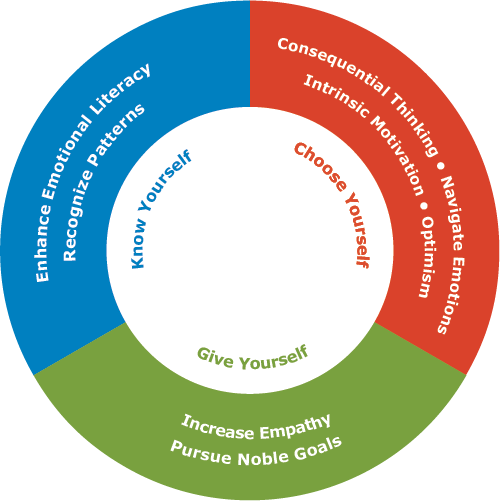
What is metacognition? In EI terms, it is becoming aware of options, weighing the value of those options, and realizing that choice is available in any situation. Self-awareness and Self-management are, according to the Six Seconds model of emotional intelligence, created through the first six EI competencies: developing emotional literacy, navigating emotions, applying consequential thinking, recognizing patterns, using optimism, and discovering intrinsic motivation. When we teach these competencies, we help children develop metacognitive skills which allow them to make good decisions in a variety of situations. At Six Seconds, we also believe that personality is not fixed, but fluid and plastic. When we practice metacognitive skills, we develop neural connections that increase our ability to understand our relationships and our environment, even as it changes.
For the second time this week, I am thrilled to find a longitudinal study that supports our conviction that children (and adults) need to develop EI competencies which will aid their individual, relational, and community-oriented success. (Another longitudinal study, the Harvard-based Grant study, emerged this month in The Atlantic, maintaining that social adeptness and relationships hold the key to both healthy aging and success and happiness in life.)
Walter Mischel is continuing his studies with schools in Pennsylvania, modeling behavior that teaches self-control. I wonder if he hasn’t missed the real point. Self-control develops from recognizing patterns, weighing consequences and using emotional data to make good choices. Intrinsic motivation is developed through the type of discussions generated by a program like Self-Science, which teaches young children to become aware of their emotions and to navigate them as they study themselves. These EI competencies are the real precursors to self-efficacy and self-control. As my dissertation research suggested, children who understand themselves develop intrinsic motivation which they are able to apply through changing outside circumstances. Shouldn’t we be teaching children to study themselves to develop EI competencies, rather that modeling behavior and rewarding its performance?
We all know how invigorating play is to our energy levels. Brain researchers are also finding that play helps keep our brains healthy. Play is a natural and needed part of life.
Here is an incredible photo shoot narrated by Stuart Brown, a physician and clinical researcher who founded the National Institute for Play.
I took the city bus to and from school starting in kindergarten or first grade. I remember riding my bike across the city to school one day (remember it because I found a $10 bill!) I was probably left a bit too much to my own devices, could be described as a “latchkey kid,” or maybe just “normal life for a kid with a working single mom.” Not a lot of supervision… but I also started my first business when I was 12 and had my own checking account, and was paying my own taxes by 16, and from then have had an (overly?) strong sense of responsibility and self-efficacy. I learned it early: I am responsible for my life.
But I am not treating my kids this way. When she was 8 or 9, Emma went into a shop by herself (mom in the car outside) and it was a big deal to let her be so independent. We live in different times! Or do we? I’ve wondered for years if there really is more danger to kids today, or we’re just hyper afraid?
So I enjoyed a “Here and Now” show today interviewing Lenore Skenazy (listen to the story). Skenzay wrote an article about letting her nine-year-old son ride the train home and unleashed a torrent of criticism that she’s “the world’s worst mom.” Recently she wrote Free Range Kids: Giving Our Children the Freedom We Had, Without Going Nuts With Worry — showing some important data — she writes a blog on the topic.
The book presents extensive statistical evidence that there is LESS child predation today than 20 or 30 years ago, and, in fact it is FAR more likely that your child will be killed in your own car driving to school than be abducted. Yet the thought of letting my 10-year-old take a bus downtown to get ice cream fills me with angst… and we put the kids in the car every day.
Just in case it’s not obvious: People are NOT rational!
In the face of this irrational but completely real and horrible fear, the facts become nearly irrelevant — and then we start making decisions carelessly. Applying emotional intelligence, we need to understand the source of the fear, recognize the pattern of reaction, and then evalute the consequences. In the face of this horrifying fear of child predation, I stop the evaluation. The trick isn’t to ignore the feeling, but rather to go further. I’m clear how I feel about the immediate risks, but how do I feel about the long term? How do I feel if I shelter them so much they lack self-efficacy? If I teach them to be afraid of the world?
To be clear, I believe in sheltering kids. There is much in the “real world” that I abhor, and I see little value in exposing them to it “so they’ll be able to cope.” The kids at 8 and 10 don’t watch commercial TV, we preview movies that aren’t rated G, and we have chosen to leave the city and live in a pastoral community surrounded by oak-covered hills and farms. Nor I do I believe in passing on a legacy of fear and helplessness. So somehow we need to find a balance of risk and safety — and perhaps Skenazy’s factual data can help us do so.
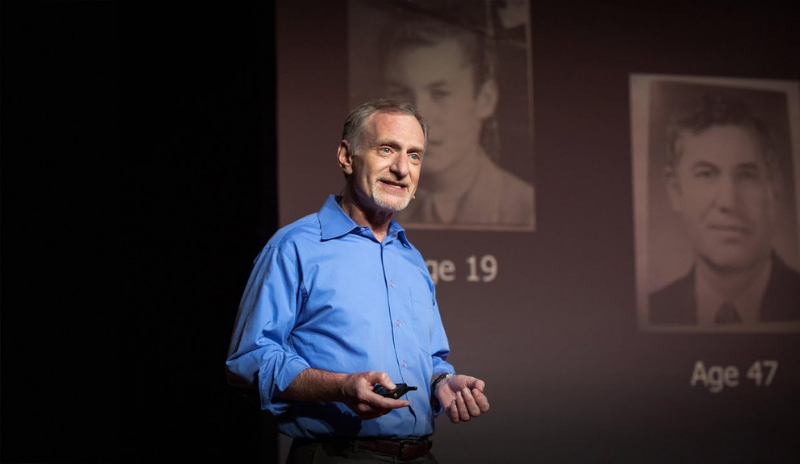
It’s an age-old question; “what makes us happy?” Is it true love? Is it fulfillment in our careers? Is it status, respect, intelligence, money, family, friends, health, or any combination of these factors? Well, we have an amazing source to turn to for some answers to this question. For 72 years, researchers at Harvard have been examining this question, following 268 men who entered college in the late 1930’s through war, career, marriage and divorce, parenthood and grandparenthood, and old age. The architect responsible for continuing the study, Dr. George Vaillant, has dedicated his career since 1967 to following the men of the Grant study. (Arlie Bock, a physician who took over the health services at Harvard in the 1930’s, conceived the project with his patron, department-store magnate W.T. Grant.) Dr. Vaillant has said, “To be able to study lives in such depth, over so many decades….it was like looking through the Mount Palomar telescope.”
Dr. Vaillant identified with the longitudinal method of research, which tracks relatively small samples over long periods of time, in 1961, while a psychiatric resident at the Massachusetts Mental Health Center. Dr. Vaillant points out that longitudinal studies, like wine, improve with age. As the Grant study men entered middle age (in the 1960”s) many achieved wonderful success. Four members of the sample ran for the U.S. Senate, one served in a presidential Cabinet, and one was president. There was also a best-selling novelist. But there were also darker stories. By age 50, almost a third of the men had at one time or another met Dr. Vaillant’s criteria for mental illness. Although the Grant study men remain anonymous, some have revealed themselves. Ben Bradlee, the long-time editor of The Washington Post and John F. Kennedy both revealed themselves as part of the study. (President Kennedy’s records have been withdrawn from the study office and sealed until 2040).
Dr. Vaillant’s central question in the analysis of the Grant men has not been how much or how little trouble the men met, but rather precisely how-and to what effect- they responded to that trouble. Calling these responses “adaptations,” or defense mechanisms in the traditional psychoanalytic tradition, Dr. Vaillant feels that adaptations shape or distort a person’s reality. There are four categories of adaptations from worst to best. The unhealthiest adaptations are “psychotic” adaptations – like paranoia, hallucination, or megalomania. The healthiest or “mature” adaptations include:
altruism (commitment to others’ wellbeing – i.e. empathy)
humor (acquired through knowing yourself)
anticipation (creating a sense of positive outcome – ie optimism)
suppression (a conscious decision to postpone an impulse or decision, to be
addressed in good time – ie consequential thinking)
sublimation (finding outlets and expressions for feelings that promote growth and
good decisions – ie, pursuing a noble goal)
Interviews, physicals, assessments with standardized instruments, and extensive physiological measurements (brain scans, heart scans etc.) have been the basis for analysis of the men’s lives. The data is rich, in qualitative style, and empirical, in the tradition of 1960’s psychological assessment. After following the study for a quarter of a century, Dr. Vaillant identified seven major factors that predict healthy aging, both physically and psychologically: employing positive adaptation, education, stable marriage, not smoking, not abusing alcohol, some exercise, and healthy weight. Dr. Vaillant has said that the major difficulty in healthy aging is alcoholism, which he termed “the horse, not the cart, of pathology.” The key to happiness, according to Dr. Vaillant? “It is social aptitude, not intellectual brilliance or parental social class, that leads to successful aging.” When asked what he had learned from his 40 year association following the Grant study men, Dr. Vaillant replied, “That the only thing that really matters in life are your relationships to other people.”
When I finished reading the article describing this study in The Atlantic recently, I was incredibly excited, struck by how much the Grant study validates the importance of Emotional Intelligence (EI). The healthiest “adaptations” are EI competencies that are a core part of the programs that we teach. Altruism is another word for Empathy; Humor is acquired through knowing yourself, being able to step back from a situation, and choosing how to respond; anticipation is a combination of understanding patterns and consequences; suppression is taking six seconds to allow emotions and cognitions to connect; and sublimation is giving yourself to others in a socially acceptable, selfless and noble manner. Dr. Vaillant’s conclusions are echoed by the work and teachings of leaders of the emotional intelligence and social-emotional learning movement: Daniel Goleman, Peter Salovey, John Mayer, Martin Seligman, Maurice Elias, the Dalai Lama, Sam Goldstein, Edward Hallowell, Roger Weissberg, Patricia Wolfe, Karen Stone McCown, Anabel Jensen, Marsha Rideout, and Josh Freedman.
We are very privileged to have the research from the Grant study to draw on. The fact that it supports the main EI precepts that we teach is incredible validation. We need to shout this to the world!!
More about the Atlantic Article is in Tessy’s EQ Planet post below
Recent conversation w a client - major deja vu. How often have I had this same discussion: what they say they do isn’t what’s happening day to day. A beautiful, compelling mission is worthless unless it lives in the the daily interactions of the organization.
It’s incredibly difficult to craft that powerful mission statement, that brief phrase that evokes the substantive and significant meaning of the organization. After years of fiddling around and finally getting the words “just right,” it’s probably pretty annoying to hear that isn’t that important. Don’t get me wrong, the “right” mission statement is incredibly important — it’s just unimportant in comparison with the real challenge: putting the mission in action.
To make a mission live requires “drilling down,” carefully focusing to align intention and action. Think about the basic activities that take place in your organization each day: What does it look, feel, and sound like to do those in accord with your mission?
For example, Six Seconds’ mission is: “Supporting people to make a positive difference, everywhere, all the time.” So how should we answer the phone? How should we respond to our colleagues when we disagree? To live that mission, how should we be defining our organizational roles, setting budgets, or even choosing what paper to buy? How about the culture we need to create — and the feelings that are essential to drive that?
Nan Summers, a friend and member of our network, once told me that when she was at Disney they had a phrase, “Everything Speaks,” meaning each little “tidbit” of the environment and the people there transmits some message… either the one intended or something else. When you drill down, you recognize what & who is speaking, and adjust that to line up with the deeper shared purpose. This requires giving up some level of autonomy — but not so much that you lose authenticity… big challenge! Emotional intelligence is invaluable here because you need to see beyond the tactical.
“Everything speaks” emotionally even more than logically — millions of subtle messages come to prevade an organization and shape a culture and climate that’s infectious. New people come in and adapt — and every interaction, every look, every nuance, ultimately transmits to the customer’s or client’s feelings of trust & loyalty.
Yet most organizations — businesses, government agencies, schools — that I encounter can barely articulate their purpose, and have little bandwidth to spare to consider how that purpose is being undermined or supported. Just imagine how, if leaders made it an absolutely priority to ensure that the mission was alive at every level, these enterprises would rocket forward. Have you ever been part of such a place?