

The Six Seconds Model of EQ
The Six Seconds model turns emotional intelligence theory into practice for your personal and professional life.
Emotional intelligence is the capacity to blend thinking and feeling to make optimal decisions — which is key to having a successful relationship with yourself and others. To provide a practical and simple way to learn and practice emotional intelligence, Six Seconds developed a three-part model in 1997 as a process – an action plan for using emotional intelligence in daily life.
This model of EQ-in-Action begins with three important pursuits: to become more aware (noticing what you do), more intentional (doing what you mean), and more purposeful (doing it for a reason).
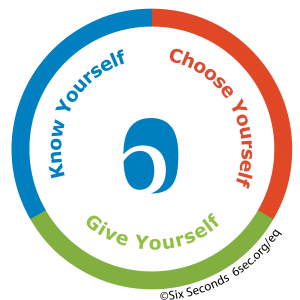
Know Yourself
Clearly seeing what you feel and do.
Emotions are data, and these competencies allow you to accurately collect that information.
Choose Yourself
Doing what you mean to do.
Instead of reacting “on autopilot,” these competencies allow you to proactively respond.
Give Yourself
Doing it for a reason.
These competencies help you put your vision and mission into action so you lead on purpose and with full integrity.
Know Yourself gives you the “what” – when you Know Yourself, you know your strengths and challenges, you know what you are doing, what you want, and what to change.
Choose Yourself provides the “how” – it shows you how to take action, how to influence yourself and others, how to “operationalize” these concepts.
Give Yourself delivers the “why” – when you Give Yourself you are clear and full of energy so you stay focused why to respond a certain way, why to move in a new direction, and why others should come on board.
You’ll notice we present the model in a CIRCLE – it’s not a list, it’s a process! The process works when you spin it, like a propeller moving a ship. As you move through these three pursuits you gain positive momentum!
Plus, here’s an intro to the model by Joshua Freedman, our CEO
Get practical tips to practice emotional intelligence
Download the Practicing EQ eBook FREE
Eight Competencies of Emotional Intelligence
“Under” the three pursuits live eight specific, learnable, measurable competencies. They’re measured through the Six Seconds Emotional Intelligence Assessment – or SEI. Here are the eight competencies – with definitions below:
| Pursuit | Competency | Definition | Learn More |
|
Know Yourself |
Enhance Emotional Literacy | Accurately identifying and interpreting both simple and compound feelings. | Emotional Literacy in Detail |
| Recognize Patterns | Acknowledging frequently recurring reactions and behaviors. | Recognize Patterns in Detail | |
|
Choose Yourself |
Apply Consequential Thinking | Evaluating the costs and benefits of your choices | Apply Consequential Thinking in Detail |
| Navigate Emotions | Assessing, harnessing, and transforming emotions as a strategic resource. | Navigate Emotions in Detail | |
| Engage Intrinsic Motivation | Gaining energy from personal values & commitments vs. being driven by external forces. | Engage Intrinsic Motivation in Detail | |
| Exercise Optimism | Taking a proactive perspective of hope and possibility. | Exercise Optimism in Detail | |
|
Give Yourself |
Increase Empathy | Recognizing, connecting with, and appropriately responding to emotions. | Increase Empathy in Detail |
| Pursue Noble Goals | Connecting your daily choices with your overarching sense of purpose. | Pursue Noble Goals in Detail |
At the core, emotional intelligence is something to BE. By being more emotionally intelligent, smarter with feelings, you will more accurately recognize emotions in yourself and others. This data will help you make decisions and craft effective solutions to the “life puzzles” you face each day. It’s also important to put it in action – hence the verbs. The three pursuits – and the eight competencies – are actions.

Account Login
login, change password

Tools System
manage assessments

EQ.org
cert eLearning & library

Knowledge Base
get how-to info

Help Desk
get tech support

Contact Us
we’re here to help

EQ Store
buy resources

TFA Online
TFA cards app

Event Calendar
quickly find all classes

- Coaching Down the Escalator: 3 Emotional Intelligence Tips forCoaches to Reduce Volatility & De-escalate Conflict in a Polarized World - March 6, 2024
- Dr. Daniel Goleman Explains the History of Emotional Intelligence - February 29, 2024
- The Upside of Uncertainty: Neuroscience for Coaching - January 30, 2024

This model is clearly understandable.
Hello,
I am the HR assistant at Dulcedo and I am reaching out to you to get more information on the Emotional Intelligence Training and our needs. If you are willing to have a virtual meeting with me to discuss in further detail please let me know and I will send you my availability.
Thanks
Do you have a course package for Dubai in 2021?
Like Accomodation + travel and course.
A colleague and I are researching different companies. We would like to go through a course and be certified on EQ.
Could you please share the course materials, take away toolkits, etc. And the fees – [email protected].
Yes. I world also be interested in learning how to become certified in EQ.
Having read this I believed it was rather enlightening.
I appreciate you finding the time and effort to put this article together.
I once again find myself personally spending a lot of time
both reading and commenting. But so what, it was still worth
it!
This is awesome. I am from India. It would be interesting if you have any program in India.
Thanks.
I’m so excited to study this Six Seconds EQ Model! Thank you for all the wonderful resources you share. I was first introduced to your Six Seconds organization in 1997 or 1998 when I purchased some Wikki Sticks for my young boys to play with. I think I’ve been getting your emails ever since….
At least two links on this page are broken; both point to the same page:
–“Tips” under “Choose Yourself” under the graphic of the model
–“Tips for Choice” under the section heading “Tips for Emotional Intelligence”
Both point to http://www.6seconds.org/2017/04/30/emotional-intelligence-tips-choice/ , which displays a page saying “No results found.”
Will you please restore these links? Thank you.
Hi Ryan! Thanks for letting us know about the broken links. They have now been restored and are working. Also glad to hear that you have been part of the community for so long!
the most impactful decision I ever made regarding myself to journey life purposefully
Is the app available for android devices. When i looked I just noticed access for the i pad and i phone. Please advise me as to how I can get it on android device. Thank You very much. Miriam
I think that six seconds is very important to use the Emotional Intelligence.
Very good, clear and simple explanation to start out with the model,thanks!
Very well developed! The flow and content is user friendly.I often tell my clients to visit the 6seconds website to get an understanding of Emotional Intelligence as well as SEI. 🙂
Yes,I have the great agreement with your suggestions in order to develop oneself ‘s intelligence.But when I explain to my students,they understand .To get success in practice ,in my opinion,is rather difficult.Many thanks
With help of EQ model and its detail knowledge life will be more happy with understanding in relation and it will spred love in people. I would like to know it. Thanks
I cam here from some post on Linkedin with that nice video but this particular video was not useful. You talk about the example with your kid…but explain process again ???…nothing specific ?
HI, can you advise wether this model is a mixed model or an ability based one please?
Love this, as a manager who wants to do well and has never understodd why I use certain phrases and ways to get results this helps me to understand me and then allows me to use this to support me team. Love it, Love it !!!!!
Good day,
Kindly update us if you have a plan to conduct Emotional Intelligence program in Dubai this year.
We look forward to hearing from you ASAP please.
Best regards and wish you a happy new year.
Doaa Awwad
Employee Development
Commercial bank of Dubai, Dubai,UAE
Hi Doaa – yes! We definitely will be running several certifications and programs in Dubai. You can see the schedule on http://6seconds.org/events — or you may wish to visit the local website for your region: http://www.6seconds-mea.com
Thanks for asking!!
Well put, Josh! This is a model that can serve us each and everyday.
Very good, clear and simple explanation for use with anyone who is starting out with the model. Thanks Josh.