White Paper:
Emotional Intelligence and Performance
Joshua Freedman, Massimiliano Ghini and Carina Fiedeldey-Van Dijk
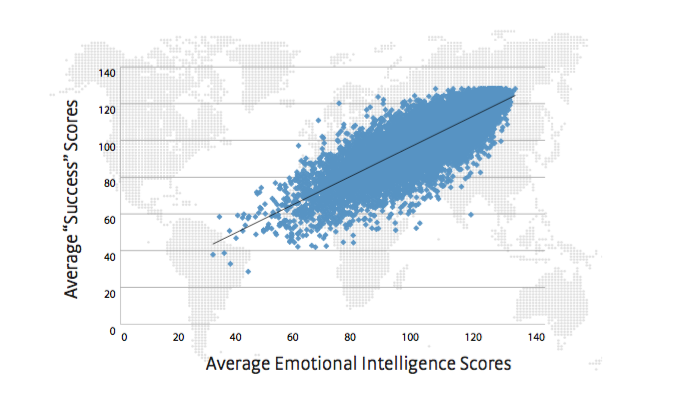
Recent research by Six Seconds’ Institute for Organizational Performance finds that 54% of critical success factors are predicted by scores on the Six Seconds Emotional Intelligence Test (SEI). This white paper explains the power and importance of this claim.
In his best-selling 1995 book, Emotional Intelligence, Daniel Goleman reported that research shows that conventional measures of intelligence — IQ — only account for 20% of a person’s success in life.[1] shows that high IQ predicts 10 to 25% of grades in college.[2] The percentage will vary depending on how we define success.
Nonetheless, Goleman’s assertion begs the question: What accounts for the other 80%? Goleman and others have asserted that at least some of the missing ingredient lies in emotional intelligence — the capacity to acquire and apply emotional information.
Conducting validation research on the Six Seconds Emotional Intelligence Test (SEI),[3] the research team assessed the importance of emotional intelligence as measured by the SEI.
The international study assessed 665 individuals ranging in ages from 18 to 65, slightly more women than men, education from some high-school education to post-graduate degrees, and a wide range of occupations and levels from entry-level to executive.
By way of external criteria to validate the SEI against, “success factors” included a wide range of measures, namely Personal Effectiveness (achieving results), Relationship Quality (networking, support), General Health (physical health and stress management), and Quality of Life (life satisfaction).
The eight scales of the SEI were analyzed to test if high scores would predict high scores on each of the success factors. The regression analysis (forward stepwise selection) found that 54.79% of the variability in these success factors combined are predicted by the SEI. The variability of each individual success factor is also predicted as shown in Figure 1. These findings make the SEI one of the strongest measures of emotional intelligence available in the market today.
What makes the SEI so strong?
The SEI is the only test measuring Six Seconds’ Model of Emotional Intelligence. The Model consists of eight core competencies divided into three key goals, Developed to help people put the theory of emotional intelligence into action in their leadership and general well-being in life, the three parts are easy to learn and apply. The competenciesare:
- Know Yourself (self-awareness)
- Enhance Emotional Literacy: recognize and appropriately express emotion
- Recognize Patterns: recognize reactions and choices
- Choose Yourself (self-management)
- Apply Consequential Thinking: evaluate the costs and benefits of choices before acting
- Navigate Emotions: learn from and transform feelings
- Increase Optimism: identify multiple options for changing the future
- Engage Intrinsic Motivation: build internal energy and drive
- Give Yourself (self-direction)
- Increase Empathy: respond appropriately to others’ feelings
- Pursue Noble Goals: align daily choices with principles and purpose
Part of the beauty of the predictive results is that the variation in each success factor is explained by that of a different combination of the eight competencies. This points to the distinct qualities of the SEI depending on the external criteria that are important to individuals and groups. The following prediction models provide insight into the specific EQ competencies that contribute to each success factor.[4]
|
Predicting Health |
Partial R2 |
Model R2 |
|
Exercise optimism |
0.2050 |
0.2050 |
|
Enhance emotional literacy |
0.0413 |
0.2464 |
|
Increase empathy |
0.0037 |
0.2501 |
|
Apply consequential thinking |
0.0012 |
0.2513 |
|
Predictive Validity |
0.2513 |
|
|
Predicting Relationship Quality |
Partial R2 |
Model R2 |
|
Enhance emotional literacy |
0.2238 |
0.2238 |
|
Act on noble goals |
0.0616 |
0.2854 |
|
Increase empathy |
0.0143 |
0.2997 |
|
Recognize patterns |
0.0060 |
0.3057 |
|
Navigate emotions |
0.0077 |
0.3134 |
|
Apply consequential thinking |
0.0034 |
0.3168 |
|
Predictive Validity |
0.3168 |
|
|
Predicting Quality of Life |
Partial R2 |
Model R2 |
|
Enhance emotional literacy |
0.3933 |
0.3933 |
|
Engage intrinsic motivation |
0.0197 |
0.4130 |
|
Exercise optimism |
0.0085 |
0.4215 |
|
Recognize patterns |
0.0033 |
0.4248 |
|
Act on noble goals |
0.0065 |
0.4313 |
|
Apply consequential thinking |
0.0020 |
0.4333 |
|
Increase empathy |
0.0016 |
0.4349 |
|
Navigate emotions |
0.0004 |
0.4354 |
|
Predictive Validity |
0.4354 |
|
|
Predicting Personal Effectiveness |
Partial R2 |
Model R2 |
|
Engage intrinsic motivation |
0.4284 |
0.4284 |
|
Enhance emotional literacy |
0.0597 |
0.4880 |
|
Apply consequential thinking |
0.0107 |
0.4987 |
|
Navigate emotions |
0.0016 |
0.5002 |
|
Act on noble goals |
0.0005 |
0.5007 |
|
Increase empathy |
0.0004 |
0.5011 |
|
Predictive Validity |
0.5011 |
|
These models provide clear evidence of the importance of the emotional intelligence competencies as conceptualized in the Six Seconds model. Research is underway hopes to confirm that EQ contributes to success in life, work, and school, and links the SEI scores to bottom-line business and quality-of-life metrics.
Background on the SEI:
To help people put the theory of emotional intelligence into practice, Six Seconds developed the three-part model in 1997. The model draws on the work of Peter Salovey, Ph.D. (one of Six Seconds’ advisory board members), and John Mayer, Ph.D. who first defined EQ as a scientific concept. It also builds on the five components of EQ popularized by Daniel Goleman in his 1995 book, Emotional Intelligence, which endorses Six Seconds’ EQ curriculum Self-Science as a model curriculum. The Six Seconds EQ model integrates leading thinking on this emerging science into a practical, useable, memorable structure.
Six Seconds is a California-based 501(c)3 not-for-profit corporation with the mission of helping all people learn to know themselves, choose themselves, and give themselves. Six Seconds provides training, consulting, and innovative tools for professionals facilitating individual and organizational change. Six Seconds consultants are available on every continent with offices in the US, Singapore, and Italy.
The Six Seconds Emotional Intelligence Test (SEI — which also means “six” in Italian) was developed and researched in Europe and has been validated in North America and Asia. The SEI questionnaire is composed of 104 items and includes two self-correcting indices and a consistency scale. This self-report questionnaire is available online or on paper in English, Italian, and Indonesian (other languages pending). Information on the assessment is online at www.6seconds.org/sei/ and the test can be purchased online via www.EQstore.com .
Notes:[1] Goleman, Daniel, Emotional Intelligence, 1995
[2] 25% – Hunter and Hunter; 10% Robert Sternberg
[3] Ghini, Freedman, Jensen, Six Seconds Emotional Intelligence Test, Six Seconds: 2004
[4] SEI-104b Analysis, Carina Fiedeldey-Van Dijk Ph.D., SEI Technical Manual “Summary of Forward Selection Procedures for Dependent Variables,” n=665, P<.05, Six Seconds, 2005
Download the PDF format of: Emotional Intelligence and Performance

Joshua,
Help. Looking for resources to respond to an RFP. Remembered liking OVS and was trying to find a recent sample report – also pricing. I found what looks like the most recent version on your website ( your organizational effectiveness survey) but was unable to download the info.
And I cannot save this page – keep getting error messages. Is it your website or my computer?
Thanks for your assistance,
Reri MacLean
Hi Reri – we’ve just added a section on Vital Signs here: http://www.6seconds.org/tools/vs/
You can find info on all three tools (Organizational, Team, and Leadership Vital Signs) and some downloadable PDFs. However – for a sample report, please contact us: http://www.6seconds.org/contact
Warmly,
-Josh